
| Key takeaway | What to enter in a GPA calculator | Why it matters |
|---|---|---|
| High school credits are not college credits | 0.5 (semester) or 1.0 (full-year) | Stops the “3 credits per class” mistake that breaks GPA math |
| Credit values measure class time | Use credits based on your schedule (semester/trimester) | Credits control how much each grade changes your GPA |
| Course level controls weighted bonuses | Pick Regular / Honors / AP / IB / Dual Enrollment | Weighted GPA can jump from 4.0 → 5.0 for the same A |
| “AP-style” is not always AP | Use Honors unless it’s an official AP [Subject] | Prevents fake +1.0 weighting that inflates GPA |
| IB weighting is school-specific | Enter IB SL or IB HL, then confirm the bonus | Some schools treat IB like Honors, others like AP |
| Dual enrollment varies a lot | Choose Dual Enrollment and set the weight your school uses | Some schools add 0.0 / 0.5 / 1.0 |
| Schedules change credit defaults | Semester = 0.5, Trimester ≈ 0.33 | Wrong term credits make GPA look “too high” or “too low” |
| California “local credits” need conversion | Divide local credits by 10 for standard credits | Fixes graduation credit confusion during transfers |
Credits & Course Level Input Guide
What a “credit” means in high school (in plain numbers)
A high school credit shows how much class time you completed. Most schools follow the Carnegie Unit idea. One credit usually equals a full year of a subject with steady class time. Many students see “credits” on a transcript and think it works like college. That mix-up causes wrong entries.
A GPA calculator works best when you enter credits like your school reports them. For most students, that means 1.0 for a full-year class and 0.5 for a one-semester class. The grade stays the same, but the credit changes the impact.
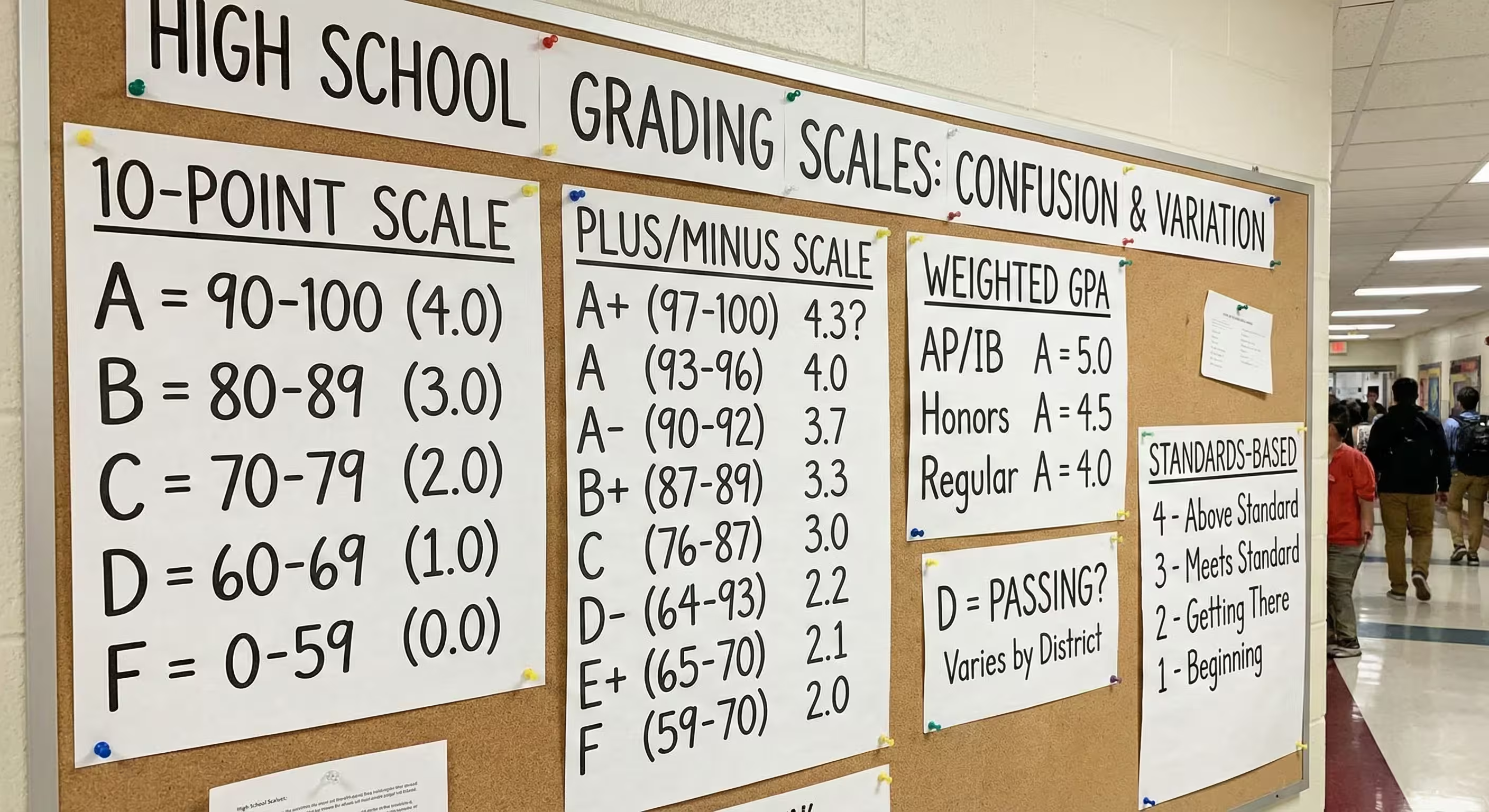
If you want the fastest setup, use a tool that already supports high school credit defaults, like the high school GPA calculator.
Full-year vs semester credits (and the special cases schools use)
Most courses fall into two simple buckets:
- Full-year course = 1.0 credit
- Semester course = 0.5 credit
Core classes like English, math, science, and history often run all year. Many electives run for one semester. A GPA calculator should let you pick 1.0 or 0.5 quickly.
Some schools add special credit values:
- Lab-based science may show extra credit (example: 1.5 total)
- Mini courses may show 0.25
- Independent study may vary by school rules
Use your transcript as the source of truth. If the transcript shows 0.5, enter 0.5. If it shows 1.0, enter 1.0.
For the math behind credit weighting, the credit hour weighting GPA guide explains why credits change the average even when grades stay the same.
Graduation credit totals: why many students go past the minimum
Most schools set a graduation target around 22–26 credits. Students often finish with more than that. Extra credits happen for normal reasons:
- You take more electives than required
- You add Honors or AP in the same year
- You repeat a class after a bad grade
- You take summer school or credit recovery
- You join dual enrollment
A common pattern looks like this:
| Year | Typical credits earned |
|---|---|
| Grade 9 | 6–8 |
| Grade 10 | 6–8 |
| Grade 11 | 6–8 |
| Grade 12 | 6–8 |
That puts many students at 24–32 total credits by graduation. A GPA calculator should not assume one fixed total. It should focus on the classes you entered and their credits.
If graduation planning feels stressful, the GPA goal setting worksheet guide can help you map what grades you need each term.
Semester, trimester, and block schedules: how to enter credits correctly
Credit entry changes with the school calendar. Most schools use a semester system. That makes credits easy: 0.5 per semester class or 1.0 for a full-year class.
Trimester schools split the year into three parts. Many students should enter 0.33 credits per trimester course. Three trimesters usually equal 1.0 credit of total time.
Block schedules change class length per day, not the credit rules. A class may meet longer each day but still count as 0.5 or 1.0 on the transcript. Always follow the transcript credit value.
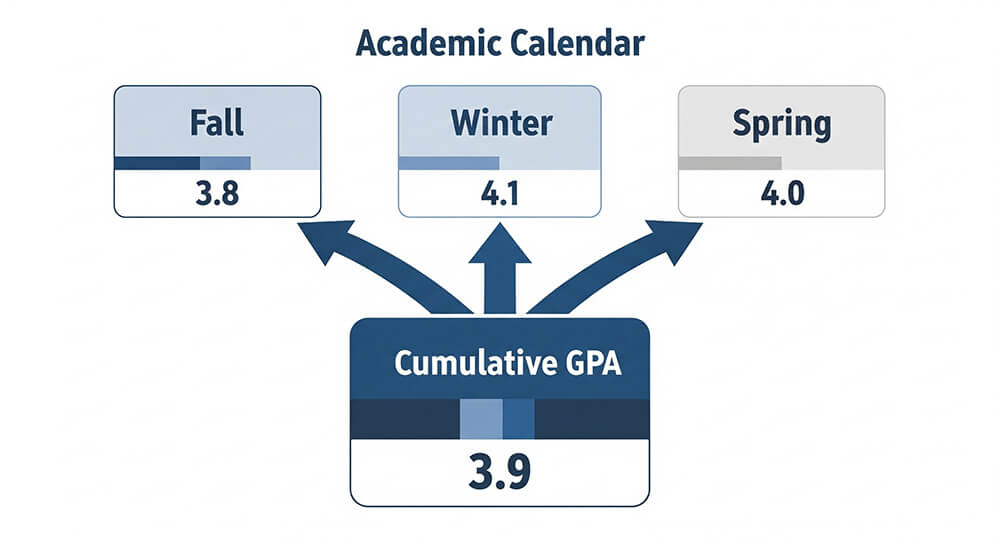
If you want a tool built for term changes, use a trimester GPA calculator or a semester GPA calculator.
The five course levels that affect weighted GPA most
Course level controls weighted GPA. Most calculators work best with a clear dropdown. These levels show up in many U.S. schools:
- Remedial / Developmental
- Regular / On-grade level
- Honors
- AP (Advanced Placement)
- IB (International Baccalaureate)
Dual enrollment often acts like a sixth option, and many schools include it.
A key rule stays true across levels: An A still starts at 4.0 unweighted. Weighting adds bonus points on top of that. Many schools use:
- Regular: +0.0
- Honors: +0.5
- AP: +1.0
- IB: +0.5 or +1.0 (school decides)
- Dual Enrollment: +0.0 / +0.5 / +1.0 (school decides)
For a deeper breakdown, the GPA weighting guide for Honors and AP helps you choose the right level.
Regular vs Honors: same credit, bigger weighted impact
Regular classes form the baseline. Honors classes usually keep the same credit value as regular classes, but they add a weighted bonus in many schools. That means Honors changes GPA without changing how many credits you earn.
Here is a simple example for a 1.0 credit class:
| Grade | Unweighted points | Weighted (Honors +0.5) |
|---|---|---|
| A | 4.0 | 4.5 |
| B | 3.0 | 3.5 |
| C | 2.0 | 2.5 |
| D | 1.0 | 1.5 |
| F | 0.0 | 0.0 |
Honors can look “harder” on a transcript, but calculators only need two inputs: grade + course level. If your school tightens the A cutoff (like 92% for an A), that affects the grade you earn, not the credit value.
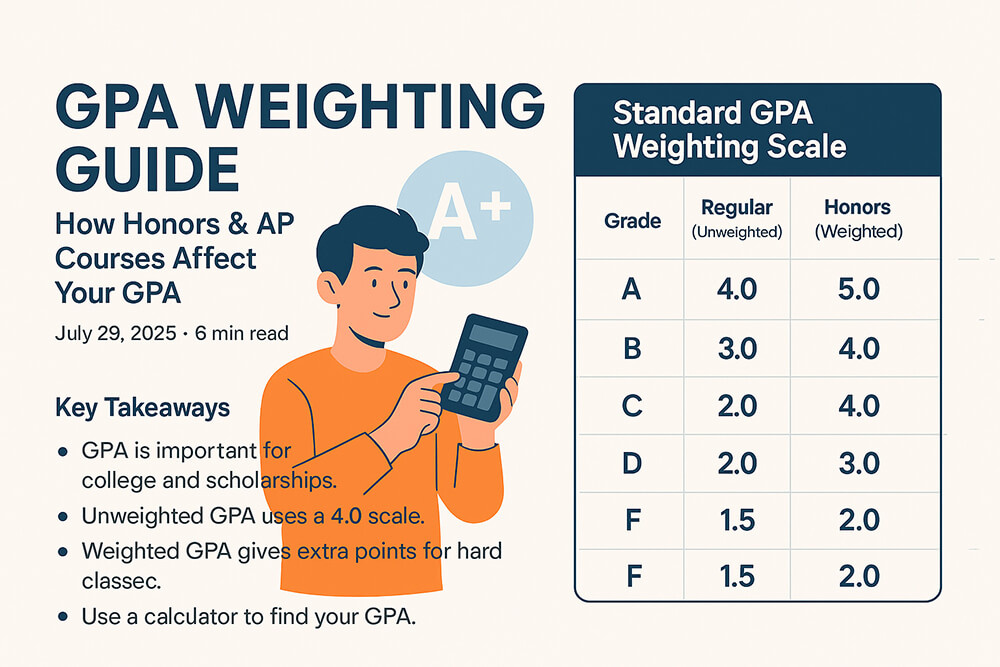
If your weighted and unweighted results confuse you, read the weighted vs unweighted GPA guide.
AP courses: how to avoid the “AP-style” trap
AP courses follow a College Board course framework and end with an AP exam. Many schools add +1.0 weighting for official AP courses. That turns a weighted A into 5.0 on a common 5.0 scale.
The biggest error: students label a class “AP” because it feels advanced. Many schools offer:
- Pre-AP
- AP-style
- AP-prep
- Honors with AP focus
Those classes often deserve Honors weighting (+0.5), not AP weighting (+1.0). The safest rule is simple: If the course title is not “AP [Subject],” treat it as Honors unless your school confirms AP weighting.
AP scores can matter for college credit later, but high school GPA math depends on course level selection. To learn how schools scale that math, see how school districts calculate GPA.
IB SL vs IB HL: same label, different workload
IB courses come in two levels:
- IB Standard Level (SL)
- IB Higher Level (HL)
HL courses require more teaching time and deeper work. Many universities respect HL more for major-related subjects. Both SL and HL still earn the same high school credits in many schools, but the workload differs.
Here is the tricky part: IB weighting has no single U.S. standard. One district may add +1.0 like AP. Another may add +0.5 like Honors. Some may add no bonus at all.
A GPA calculator should let you:
- pick IB SL or IB HL
- set the IB bonus in settings (0.5 or 1.0)
- save that setting for future terms
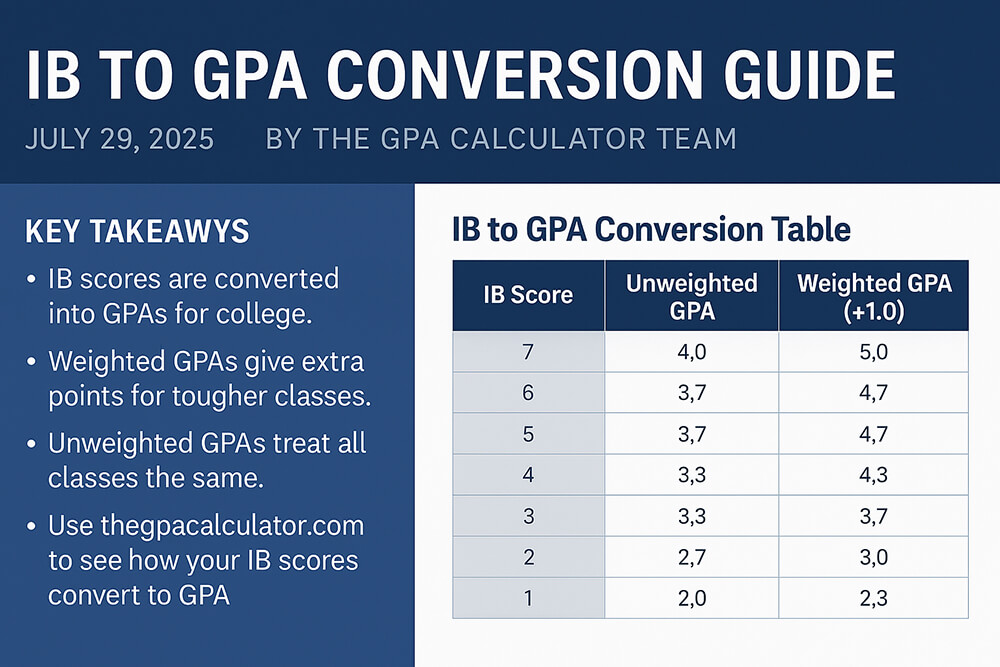
For more school-friendly conversions, use the IB to GPA conversion guide.
Dual enrollment: why the weight and credit rules change by school
Dual enrollment means you take a real college class while in high school. You may earn high school credit and college credit at the same time. The GPA confusion happens because schools treat dual enrollment in different ways.
Common dual enrollment rules:
- Some schools weight it like AP (+1.0)
- Some weight it like Honors (+0.5)
- Some do not weight it (+0.0)
Your transcript often shows the high school credit value (0.5 or 1.0). The college credit (like 3 credits) is separate and should not go into a high school GPA calculator.
Dual enrollment can help with transfer plans, but credit acceptance varies by college. If you plan to move schools, the community college transfer GPA guide and the transfer credits GPA integrator can reduce surprises.
The best course entry fields to collect for accurate GPA math
A clean GPA entry row needs only a few inputs. More fields help organization, but they should stay optional.
Required fields
- Course level (Regular / Honors / AP / IB / Dual Enrollment)
- Grade (A–F or A+, A, A-… if your school uses ±)
- Credits (0.5 or 1.0 in most cases)
Helpful optional fields
- Course name (Example: “AP Calculus BC”)
- Term (Fall / Spring / Summer)
- Subject (Math, English, Science, Elective)
- Notes (retake, transfer credit, pass/fail)

If you want a fast manual backup, the high school GPA calculator template in Google Sheets works well. For the formula logic, use the GPA formula guide.
Common calculator input mistakes (and the fastest fixes)
Most GPA errors come from two issues: wrong credits or wrong course levels. Fixing them takes seconds if you know what to check.
Mistake 1: Entering “3” credits
- Fix: Use 1.0 (full-year) or 0.5 (semester)
Mistake 2: Labeling “Pre-AP” as AP
- Fix: Use Honors unless the course is official AP
Mistake 3: Using random course level names
- Fix: Use a dropdown like “Regular / Honors / AP / IB”
Mistake 4: Forgetting dual enrollment is school-specific
- Fix: Ask your counselor which weight your school uses
Mistake 5: Ignoring ± grades
- Fix: Match the grading scale on your transcript
For a full checklist of problems and fixes, use common GPA calculation errors to avoid.
Transfer credits, retakes, pass/fail, and California local credits
Real transcripts include edge cases. A strong calculator should handle them without forcing guesswork.
Transfer credits Some schools count the credit but do not count the grade in GPA. Others count both. Use a “transfer credit” toggle if possible. The transcript GPA audit guide helps you match calculator results to your transcript.
Retakes Schools may replace the old grade, average both, or keep both. A retake checkbox should ask what policy your school uses. If you need a clean redo, try a repeat course GPA recalculator.
Pass/Fail Pass/fail often gives credit but no GPA points. That can protect GPA but still meet requirements. See how pass/fail grades impact your GPA.
California local credits If your transcript shows “local credits,” divide by 10 to get standard credits.
Frequently Asked Questions
What credits should I enter for a normal full-year class?
Enter 1.0 credit for most full-year classes and 0.5 for most semester classes. If your transcript lists a different value, follow the transcript.
Can a weighted GPA go over 4.0?
Yes. Weighted systems often add bonus points for Honors, AP, IB, or dual enrollment. The 5.0 GPA scale guide explains the most common setups.
Is “AP-style” the same as an official AP course?
No. “AP-style” and “Pre-AP” often count as Honors in GPA weighting. Official AP courses usually include the title AP [Subject]. Use the GPA weighting guide for Honors and AP to choose correctly.
My school uses trimester classes. What credit value should I enter?
Many trimester schools use about 0.33 credits per trimester course. Three trimesters add up to about 1.0 credit for a full year. The trimester GPA calculator helps you track terms cleanly.
How do I convert letter grades into GPA points?
Most schools map A–F to a 4.0 scale, sometimes with plus/minus values. Use the letter to point GPA conversion guide for accurate point values.
Does dual enrollment count toward my high school GPA?
Often yes, but schools treat it differently. Some weight it like AP, some like Honors, and some do not weight it. For transfer planning, use the transfer credits GPA integrator.
What should I do if my calculated GPA does not match my transcript?
First check credits (0.5 vs 1.0). Then check course level (Honors vs AP). Then check if your school drops grades, replaces retakes, or excludes transfers. The how to calculate GPA page can help you audit the math.
Can pass/fail classes help my GPA?
Pass/fail usually gives credit without changing GPA points. That can protect GPA during a hard term, but rules vary by school. The pass/fail grades impact guide explains the common outcomes.
Where can I calculate everything in one place?
Use The GPA Calculator for quick results, and pair it with the college GPA calculator if you also track college coursework.