
Key Takeaways
| Question | Best Answer |
|---|---|
| What is unweighted GPA? | A simple 0.0–4.0 scale where every class counts the same. |
| What is weighted GPA? | A GPA that adds bonus points for Honors/AP/IB, so it can go above 4.0. |
| Which one do colleges care about most? | Colleges usually trust your transcript + course rigor, and often recalculate GPA their own way. |
| Is a 3.8 unweighted always worse than a 4.0 unweighted? | No. A 3.8 with hard classes can look stronger than a 4.0 with easy classes. |
| What should students focus on? | Strong grades + smart rigor, based on what your school offers and what you can handle. |
Weighted vs unweighted GPA: the real difference in plain words
Weighted vs unweighted GPA is one idea: do harder classes change the number? An unweighted GPA says “no.” An A is an A, no matter the class. A weighted GPA says “yes.” An A in AP earns more points than an A in a regular class.
That sounds simple, but many students get stuck on the score alone. A 4.0 unweighted can look perfect, but it can hide a low course level. A 3.7 unweighted can look lower, but it may come from a heavy AP schedule.
If you want the clearest picture fast, use a high school GPA calculator and compare both numbers side by side using the High School GPA Calculator: https://thegpacalculator.com/calculator/high-school

What unweighted GPA actually measures
An unweighted GPA uses a 4.0 scale and treats every course the same.
Most schools use this basic point system:
- A = 4.0
- B = 3.0
- C = 2.0
- D = 1.0
- F = 0
Then you add the points from all classes and divide by the number of classes.
The biggest rule: unweighted GPA cannot go above 4.0. Even if you take 10 AP classes and earn all A’s, your unweighted GPA still caps at 4.0.
Unweighted GPA helps because it is easier to compare across schools. A 3.8 unweighted in one state means the same thing in another state. That’s why students often track it using a cumulative GPA calculator: https://thegpacalculator.com/calculator/cumulative
What weighted GPA actually measures
A weighted GPA adds extra points for harder classes like Honors, AP, or IB.
A common setup looks like this:
- Regular A = 4.0
- Honors A = 4.5
- AP/IB A = 5.0
This system rewards course difficulty. It tells your school, “This student did well while taking harder work.”
Weighted GPA also helps explain “why” two students can earn the same letter grade but show different effort. A B in AP Chemistry often takes more work than a B in regular Chemistry.
If you want to understand how schools apply those bonus points, this guide helps: weighted GPA guide /blog/weighted-gpa-guide You can also see how schools handle Honors and AP rules here: Honors/AP weighting rules /blog/gpa-weighting-guide-honors-ap
Why your GPA scale matters more than you think
One student says, “I have a 4.3 GPA.” Another student says, “Same, me too.” They might not be equal at all.
Schools use different scales:
- 4.0 scale (usually unweighted)
- 5.0 scale (common weighted)
- 6.0 scale (less common, but real)
So a 4.3 from one school may mean “very strong,” while a 4.3 from another school may mean “average.”
This is why students feel confused when they compare friends. The number alone is not enough. You need the scale and the course levels.

If your school uses a system that feels “weird,” this helps explain the rules: how school districts calculate GPA /blog/how-school-districts-calculate-gpa
Real example: Student A vs Student B (same effort, different story)
Student A takes only regular classes and earns all A’s.
- Unweighted: 4.0
- Weighted: 4.0
- Gap: 0.0
This looks perfect, but it raises one question: Did the student take hard classes?
Student B takes some honors classes and earns a mix of A’s and B’s.
- Unweighted: 3.5
- Weighted: 4.0
- Gap: +0.5
Student B’s weighted GPA tells a story: “This student chose harder work.” Student A’s GPA tells a story too: “This student stayed safe.”
Many selective schools prefer students who show strong grades and strong challenge. This guide explains the tradeoff in simple terms: weighted vs unweighted GPA /blog/weighted-vs-unweighted-gpa
Real example: Student C vs Student D (why a lower unweighted can win)
Now look at students who take a lot of advanced classes.
Student C takes some regular, honors, and AP courses with mostly A’s and one B.
- Unweighted: about 3.9
- Weighted: higher because of the AP boost
Colleges often see this and think: “One B in AP is not scary. The student tried hard work.”
Student D takes mostly AP/IB classes and earns A’s and a few B’s.
- Unweighted: around 3.6–3.8
- Weighted: around 4.4–4.5
Student D can look stronger than Student A with a 4.0. Why? Student D shows readiness for harder college courses.
If you want to compare profiles like this, use the weighted vs unweighted GPA calculator: /blog/weighted-vs-unweighted-gpa-calculator
The “one B” test: why weighted GPA can feel less painful
One B can change your GPA fast on an unweighted scale.
Example: 6 classes, 5 A’s, and one B.
- Unweighted points: (5×4.0 + 1×3.0) ÷ 6 = 3.83
Now imagine that B is in an AP class and your school weights AP:
- Weighted points: (5×5.0 + 1×4.0) ÷ 6 = 4.83
That is a full 1.0 difference. The grades did not change. Only the course level changed the math.
This is why weighted GPA can “buffer” one hard B. It shows the class was tough. Unweighted GPA does not show that context by itself.
To see how one grade changes your result, a quick tool helps: mid-term grade projection slider /blog/mid-term-grade-projection-slider
What colleges actually look at on your transcript
Most colleges do not trust one school’s weighted GPA system. Schools weight courses in different ways, so the numbers do not match.
Colleges often do this instead:
- They read your transcript
- They note course rigor (Honors/AP/IB)
- They compare grades in context
- They recalculate GPA using their own rules
So a student with a 3.8 unweighted in hard classes can look better than a student with a 4.0 unweighted in easy classes.
If your goal is college admission, these pages help you stay realistic:
- GPA requirements for college admissions /blog/gpa-requirements-for-college-admissions
- weighted GPA myths debunked /blog/weighted-gpa-myths-debunked
- transcript GPA audit guide /blog/transcript-gpa-audit-guide
How to choose classes without hurting your GPA
A smart schedule helps more than a “max difficulty” schedule.
Use this simple rule:
- Take the hardest classes you can earn strong grades in
- Avoid stacking so many hard classes that your grades crash
A student with good grades in AP + honors looks strong. A student with many AP classes and many C’s looks stressed and inconsistent.
If your school offers Honors and AP, the best path is usually balance:
- 1–3 advanced classes you enjoy
- Strong grades in core classes
- Steady study habits
This guide helps with better daily results: study tips for better grades /blog/study-tips-for-better-grades And this page explains how bonus points work by course level: GPA weighting for honors and AP /blog/gpa-weighting-guide-honors-ap

How to calculate your high school GPA the right way
Many students calculate GPA wrong for one reason: they mix systems.
Common mistakes include:
- Mixing semester grades with final grades
- Using the wrong scale (4.0 vs 5.0)
- Forgetting credits or course weight
- Counting pass/fail like a letter grade
A clean method helps you avoid panic.
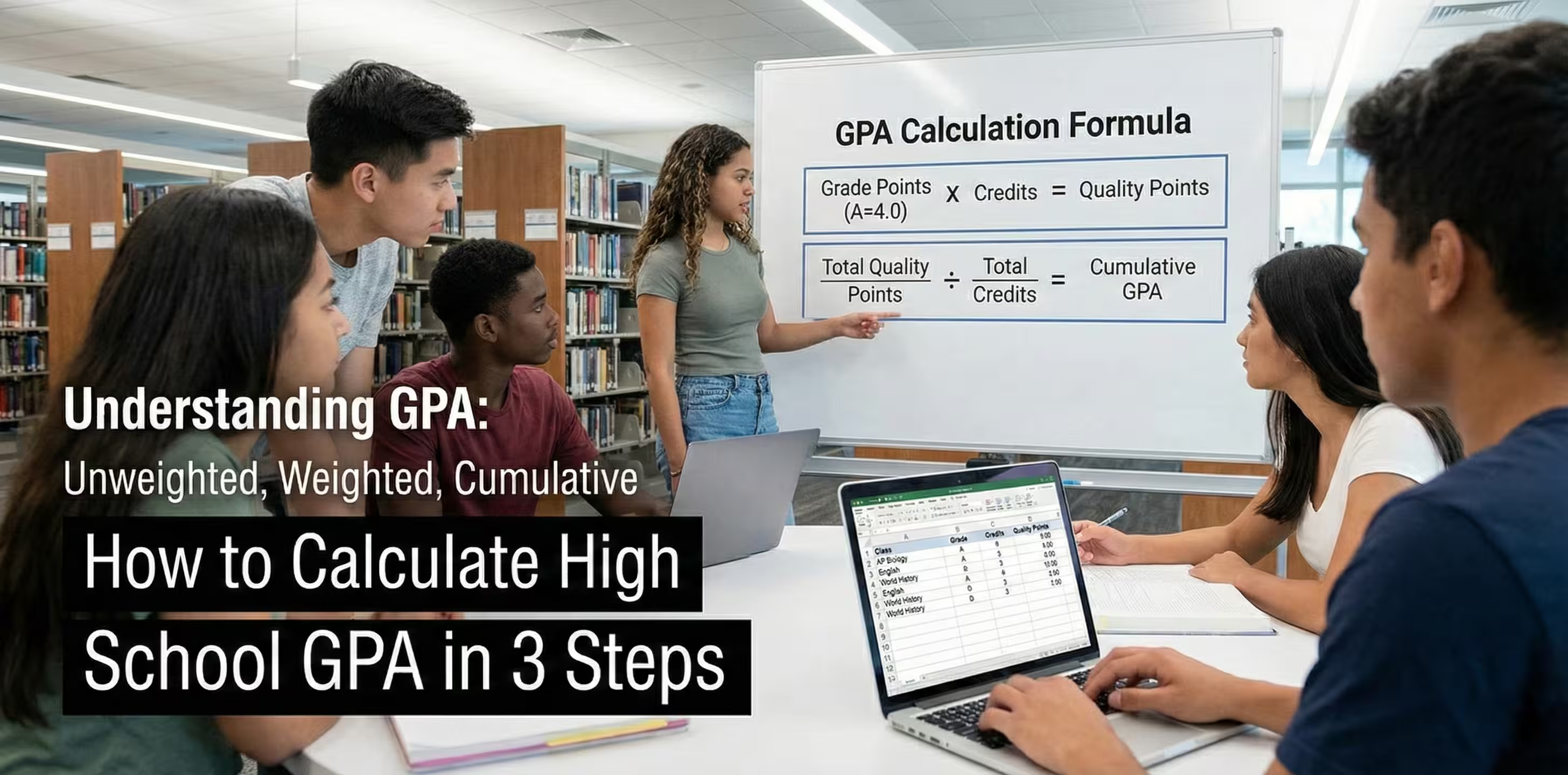
If your GPA looks “off,” check these guides:
- how to calculate high school GPA /blog/how-to-calculate-high-school-gpa
- common GPA calculation errors /blog/common-gpa-calculation-errors-to-avoid
- why GPA does not match transcript /blog/why-gpa-does-not-match-transcript
Why your GPA may not match your transcript
Students often say, “My GPA is different on the website than my report card.”
That happens for normal reasons:
- Your school adds weight only to some classes
- Your transcript uses year-long grades, not quarter grades
- Your district weights Honors, but not AP (or the opposite)
- Some classes count as credits, some do not
You should trust your transcript first, then use tools to explain the gap.

To fix the mismatch, these pages help:
- credits and course level input guide /blog/credits-and-course-level-input-guide
- quality points vs GPA explained /blog/quality-points-vs-gpa-explained
- letter to point GPA conversion guide /blog/letter-to-point-gpa-conversion-guide
Use a GPA calculator to test real “what if” choices
A good GPA calculator helps you answer real questions like:
- “If I take 2 AP classes and get two B’s, will my GPA drop a lot?”
- “If I take Honors instead of regular, does it help?”
- “Is my friend’s weighted GPA even comparable to mine?”
That is why showing both weighted and unweighted GPA matters. The gap tells a story:
- Small gap = mostly regular classes
- Large gap = many Honors/AP classes
Use these tools to model your options:
- High School GPA Calculator https://thegpacalculator.com/calculator/high-school
- college GPA calculator /blog/college-gpa-calculator
- semester GPA calculator /blog/semester-gpa-calculator

International students: convert your grades the smart way
If you studied outside the US, your grades may use:
- 100-point scales
- 10-point CGPA systems
- class ranking systems
- different passing rules
That does not mean your grades are “worse.” It means your scale is different.
A conversion guide helps you translate your numbers into something US schools understand.

Helpful tools:
- international GPA converter guide /blog/international-gpa-converter-guide
- UK class system to 4.0 conversion /blog/uk-class-system-grades-to-4-0-gpa-conversion
- China 100-point to 4.0 conversion /blog/china-100-point-gpa-to-4-0-scale-conversion-guide
- Indian 10-point to 4.0 conversion /blog/indian-10-point-gpa-to-4-0-scale-conversion
Weighted vs unweighted GPA matters most for this reason
Here is the truth most students miss:
- Weighted GPA matters a lot for your school awards
- Unweighted GPA matters more for fair comparison
- Colleges care most about grades + course rigor
So you do not need to chase a perfect weighted score. You need a plan you can keep.
A strong plan looks like this:
- Take advanced classes you can handle
- Keep your grades steady across subjects
- Use tools to track progress before final grades hit
If you need a simple system to aim higher, these guides can help:
- raise my GPA action plan /blog/raise-my-gpa-action-plan
- GPA goal setting worksheet /blog/gpa-goal-setting-worksheet-guide
- freshman year GPA predictor /blog/freshman-year-gpa-predictor
Frequently Asked Questions
What looks better: a 4.0 unweighted or a 4.3 weighted?
A 4.0 unweighted looks clean and strong. A 4.3 weighted can look even stronger if it comes from hard classes. Colleges will read your transcript either way. Use a tool that shows both numbers: /blog/weighted-vs-unweighted-gpa-calculator
Do colleges recalculate weighted GPA?
Many colleges do. They often convert grades into their own format so they can compare students fairly. This is why course rigor matters as much as the number: /blog/weighted-vs-unweighted-gpa-guide
Is one B in AP a big deal?
Usually no. A B in AP can show you took a challenge and still did well. Weighted GPA often makes that B look less damaging than unweighted GPA does. You can model the impact here: /blog/mid-term-grade-projection-slider
Why is my weighted GPA so much higher than my unweighted GPA?
A big gap often means you take many Honors/AP classes. That gap is normal in a weighted system. If your number looks “too high” or “too low,” check this: /blog/how-school-districts-calculate-gpa
What is a “good” GPA for most colleges?
A 3.0+ is often competitive. A 3.5+ is strong. A 3.8+ is very strong for many schools. Selective programs can expect higher. This guide breaks it down: /blog/gpa-requirements-for-college-admissions
How do I calculate my high school GPA by hand?
Convert each grade to points, add them up, and divide by the number of classes. Then apply weighting rules if your school uses them. A clear walkthrough is here: /blog/how-to-calculate-high-school-gpa
What if my GPA does not match my transcript?
This happens a lot because of different rounding rules, credit rules, or course weights. Start here to spot the cause fast: /blog/why-gpa-does-not-match-transcript
Can I compare my GPA to my friend’s GPA?
Only if you share the same scale and weighting rules. If one school uses a 5.0 scale and another uses 6.0, the numbers do not match. This guide makes it clear: /blog/4-0-vs-5-0-vs-6-0-gpa-scales