
| Key takeaway | What it means for Unweighted GPA With Pass/Fail Courses | Quick action |
|---|---|---|
| Pass does not raise GPA | A Pass (P/CR) adds no quality points, so it never boosts an unweighted GPA | Use a calculator that models P/F correctly |
| Pass can slightly lower GPA | Credits still count as attempted hours at many schools, so the GPA math can dip | Test your “letter grade vs pass” scenarios |
| Fail is a GPA disaster | A Fail (F/NP/U) usually counts like an F = 0.0, which can drop GPA fast | Only choose P/F if you can safely pass |
| Policies change by school | Some high schools exclude P/F from GPA; many colleges limit P/F to electives | Check your school rules before switching |
| Transfer and grad programs may reject P | A “P” can block prerequisites or major credit, even if your GPA stays fine | Avoid P/F for prerequisites and major cores |
Start with a quick test in the cumulative GPA calculator, then compare with your school’s rules using how pass/fail grades impact your GPA.
Unweighted GPA With Pass/Fail Courses
What “unweighted GPA” means when you add pass/fail
Unweighted GPA tracks grades on a 0.0–4.0 style scale. It uses quality points from letter grades (A, B, C, D, F). Pass/fail looks simple, but it can change the math in ways students miss. A “Pass” often gives credit but no quality points, so it does not lift your GPA. A “Fail” often counts like an F, which can crush your GPA in one term.
Many students also mix systems. One class uses letters. Another uses pass/fail. A third uses plus/minus. Your transcript can still show a clean GPA, but the hidden rule is: quality points drive GPA. If a course adds credits but adds zero points, your number may drop.

To see the parts that count, use what counts in unweighted GPA and quality points vs GPA explained.
The GPA formula that makes pass/fail feel “weird”
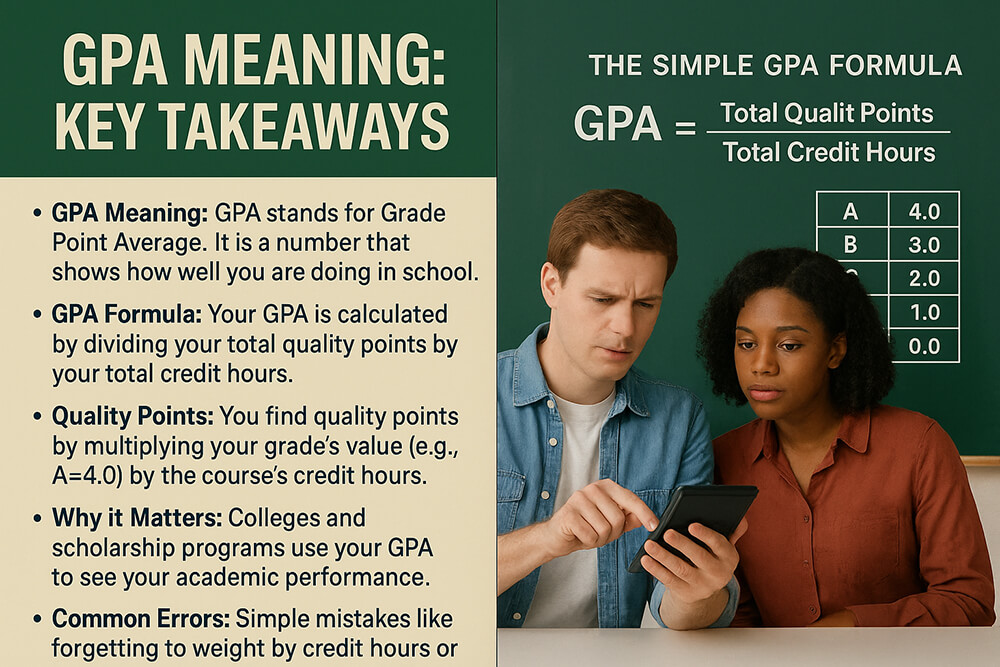
Most unweighted systems use one core formula:
GPA = total quality points ÷ total attempted credit hours
Letter grades add both points and credits. Pass/fail often adds credits only when you pass. That creates the weird feeling. You did the work. You earned the credit. Your GPA still does not go up.
This is why you should watch the denominator. Attempted hours sit in the bottom of the fraction. If attempted hours rise while points stay flat, the fraction can shrink. Some schools also treat “P” credits as earned but not attempted for GPA. Others count them as attempted for progress rules. So the same “P” can affect GPA math, honors rules, and aid rules in different ways.
For clean math, review GPA formula guide and credit hour weighting GPA guide.
Why a Pass does not help GPA (and can lower it)
A Pass gives 0.0 quality points in most policies. If your school still counts the credits in the GPA denominator, your GPA can drop.
Example (simple and common):
- 4 classes with A grades: 16 quality points ÷ 4 credits = 4.0 GPA
- 3 A grades + 1 Pass: 12 quality points ÷ 4 credits = 3.0 GPA
That drop feels unfair, but it follows the formula. The pass added credit hours without adding points.
Some schools avoid this by excluding P/F credits from the GPA calculation. Others do not. You must treat “P” as “neutral at best” unless you confirm the rule. If you use a tool that assumes “P” is an A, your plan breaks.

Run your numbers in how to calculate GPA, then validate the result with how pass/fail grades impact your GPA.
Why a Fail in pass/fail is worse than a low letter grade
A Fail in a pass/fail class often posts as F / NP / U and counts as 0.0 quality points. That is the same points as an F in a letter-grade course. The shock comes from what you could have earned with a low letter grade.
A low letter grade can still give some points:
- D can give 1.0 per credit
- D− can give 0.7 per credit
- Pass/fail fail gives 0.0 per credit
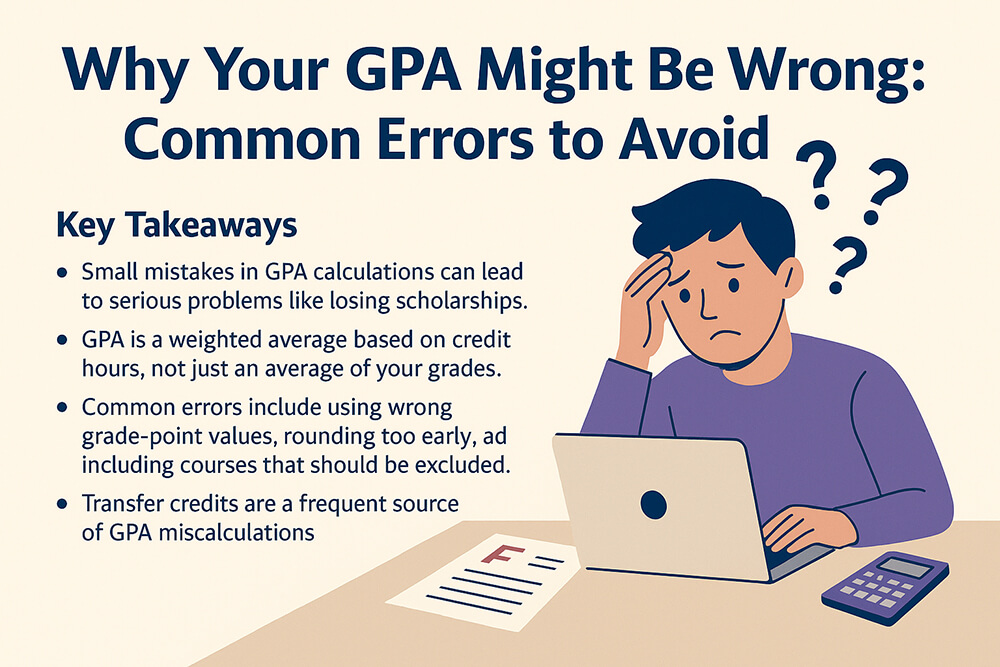
So a student who “barely passes” a letter-graded class may protect GPA more than a student who fails a pass/fail class. One fail can drop a strong GPA by a large chunk because it adds credits with zero points.
If you feel unsure about passing, P/F can be the most dangerous option.
Use common GPA calculation errors to avoid and letter to point GPA conversion guide to compare “D” vs “F” outcomes.
High school pass/fail vs college pass/fail: not the same story
High school pass/fail options are uncommon. When schools do use them, they often exclude pass/fail grades from GPA or give them a weight of 0. That means the P/F course can satisfy a requirement, but it may not move the GPA at all.
Colleges use pass/fail more often, but they set tight limits. Many schools restrict P/F to electives. Many schools block P/F for major requirements or prerequisites. Schools also set a minimum letter level for “Pass,” like C− or C. That rule matters because it changes your risk.
So you need two checks:
- Does the course count in GPA math?
- Does the course count for what you need next (major, transfer, grad, aid)?
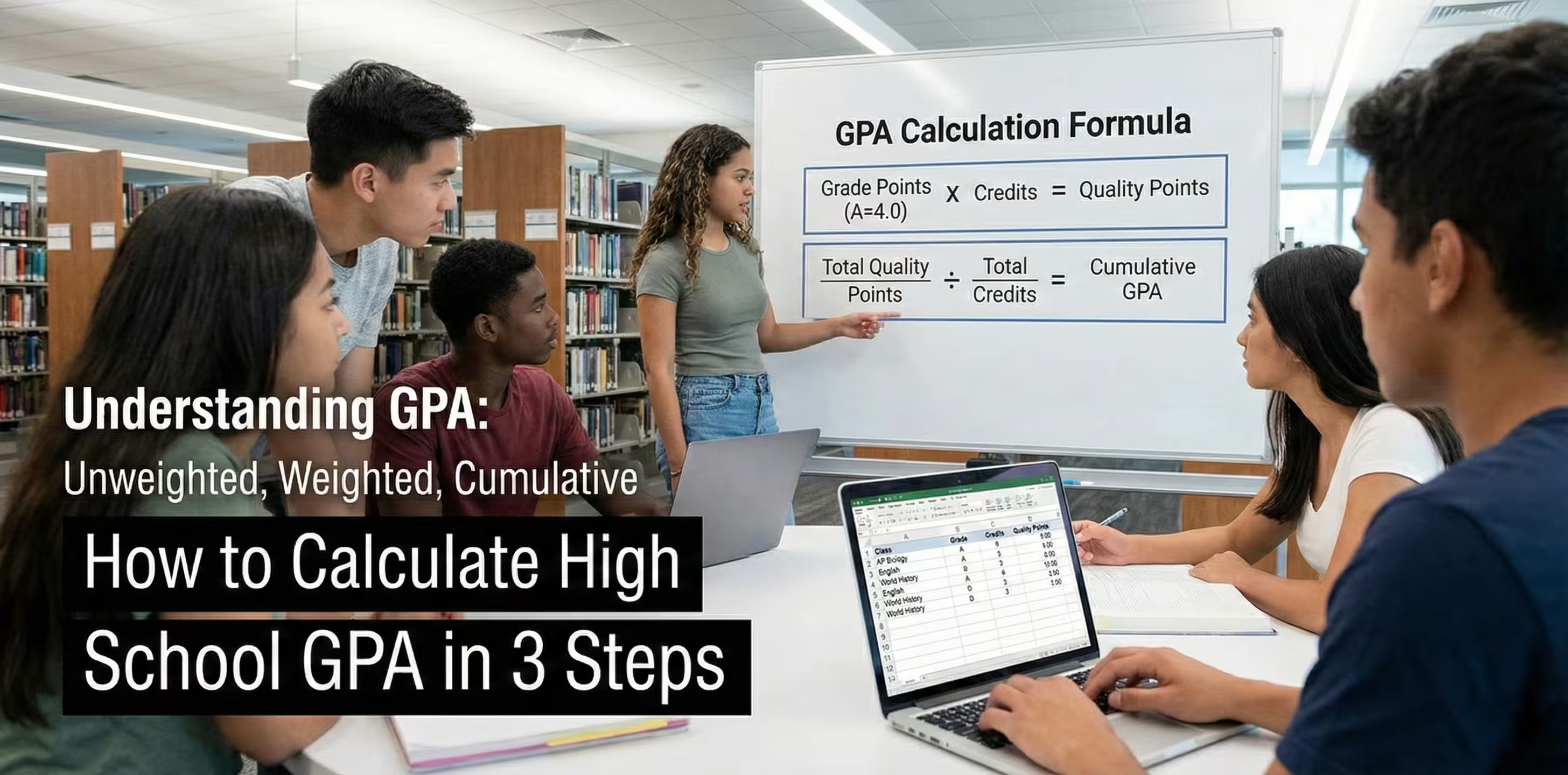
If you track high school records, use high school GPA calculator and how to calculate high school GPA.
Pass/fail caps, major rules, and prerequisite rules
Most colleges limit how many pass/fail credits you can take. A school can allow a few credits, then block any more. The school can also allow P/F in electives, but reject it in:
- major core courses
- prerequisite sequences
- courses needed for licensure tracks
These rules matter because a “P” can save stress today but cost time later. You may need to retake the same course for a letter grade to meet a program rule. That can delay graduation, increase cost, and damage momentum.
If you plan a professional path (nursing, engineering, business, pre-health), you should treat prerequisites as “letter-grade only” unless the program clearly accepts “P.”

Use core vs elective GPA and prerequisite-only GPA calculator before you switch grading modes.
Transfer students face a hidden pass/fail trap
Transfer rules cause the biggest surprise. A receiving school can accept your credits, reject your credits, or accept them as “elective only.” Pass/fail grades raise the odds of the worst outcome, especially for major courses.
A “P” in biology, engineering, or business can transfer as general credit and still fail to meet the major requirement. Then you retake the same class. You lose time. You pay again. Your graduation plan slips.
If you might transfer, a lower letter grade often beats a pass/fail grade because it shows clear mastery and meets more policy checks. The goal is not a prettier transcript. The goal is credit that actually counts.

Plan with community college transfer GPA guide and model outcomes using transfer credits GPA integrator.
Graduate and professional programs: “P” can block requirements
Graduate and professional programs often look past your school’s GPA rules. They ask: “Did you complete the prerequisite with a real grade?” Many programs prefer letter grades because they compare applicants across schools.
This hits hardest in health and licensure paths. A pass in a prerequisite can fail to satisfy a requirement, even if your GPA stays high. Programs may accept P/F in unusual periods (like emergency policy years), but most programs prefer standard grading when you have the choice.
If you aim at professional programs, you should treat P/F as a last resort for non-core electives. Keep your prerequisites clean and comparable.

Check standards in GPA benchmarks for professional programs and grad school GPA requirements guide.
Med, dental, nursing, and engineering: specific risks with pass/fail
Some fields have extra screening rules:
- Medical school pipelines often treat “P” as credit only and still want letter-graded science prerequisites.
- Dental programs can weigh science GPA heavily, so unclear grades can hurt clarity.
- Nursing programs often set minimum GPAs and may require letter grades in core sciences.
- Engineering licensure tracks can demand strong proof of mastery in core courses.
A pass/fail grade can protect your mental load short term, but it can reduce the proof you need later. If you take P/F, keep it to electives that do not sit in the prerequisite chain.

Compare paths using medical school GPA averages AMCAS 2024-2025 and nursing BSN vs ADN GPA requirements.
Financial aid and SAP: pass/fail can still cause trouble
Financial aid offices often track Satisfactory Academic Progress (SAP). SAP usually has two parts:
- GPA standard (qualitative)
- completion pace (quantitative)
A “Pass” can help pace because you earn credits. A “Fail” can hurt both sides. The fail adds attempted credits, but you do not complete them. That can push you below pace rules and drop your GPA at the same time.
Too many P/F choices can also affect honors lists, scholarships, and academic standing rules. Schools can treat P/F credits as “not graded” for certain awards. You can keep a good GPA and still lose eligibility.

Review a student’s guide to satisfactory academic progress SAP and academic probation rules by state if aid feels at risk.
A simple decision checklist for choosing pass/fail
Use pass/fail when these statements are true:
- The class is a non-major elective
- You can pass with high confidence
- You do not need it as a prerequisite
- You do not expect to transfer the credit for a major
- You stay under your school’s P/F cap
Avoid pass/fail when these statements are true:
- The course sits in your major core
- The course is a prerequisite for a program you want
- You might transfer in the next year
- Your GPA is borderline and you cannot afford surprises
- Your aid or scholarship has strict progress rules
This checklist keeps you out of the common trap: a pass that “feels safe” but creates a later requirement problem.

If the goal is grade rescue, try study tips for better grades and build a plan with raise my GPA action plan.
Model your scenarios with the right calculators and planners
You should test three paths before you lock a grading choice:
- Take the letter grade as-is
- Switch to pass/fail and assume you pass
- Switch to pass/fail and assume the worst-case fail
This is not fear. This is math. A small change in quality points can shift your GPA more than you expect, especially early in college when you have fewer credits.
Use a tool that handles credit hours and grading types clearly. If your transcript uses plus/minus, test that too. If you might repeat the course, compare “repeat” policies and grade replacement rules.

Start with the cumulative GPA calculator, then test retakes with repeat course GPA recalculator.
Frequently Asked Questions
Does a Pass increase my unweighted GPA?
A Pass usually adds zero quality points, so it does not raise an unweighted GPA. Many schools still count the credits as attempted hours, which can slightly lower the GPA math. If your school excludes P/F credits from GPA, your GPA may stay the same. Verify the rule, then test it with a calculator. Try college GPA calculator for a term-level check.
Does a Fail in pass/fail count as an F?
In many systems, yes. A fail often posts as F/NP/U and counts as 0.0 quality points. That can drop GPA fast because it adds attempted credits with no points. If you want a clear comparison, use letter to point GPA conversion guide.
Should I use pass/fail to “protect” my GPA from a B or C?
It depends on your goals. A single B rarely blocks long-term plans, but a pattern of P/F in key courses can raise questions, and it can block prerequisites or transfer credit. If the course is a core requirement, a letter grade is often safer. Use weighted vs unweighted GPA guide to keep your reporting clean.
Will graduate schools accept pass/fail prerequisites?
Many graduate and professional programs prefer letter grades for prerequisites. Some may accept a P for electives but still require letter grades in core sequences. Always treat prerequisites as “letter-grade first” unless the target program says “P accepted.” Check grad school GPA requirements guide and GPA benchmarks for professional programs.
I might transfer. Should I avoid pass/fail?
Most transfer policies accept letter-graded credits more easily, especially for major requirements. A “P” can become elective credit and force a retake. If transfer is possible, lean to letter grades for major and prerequisite courses. Use transfer credits GPA integrator to plan how credits may apply.
What is the safest way to choose pass/fail?
Pick pass/fail only when the course is a true elective, you can pass with confidence, and you have no transfer or prerequisite needs tied to it. Then run worst-case math (what if you fail) so you understand the risk. The simplest way is to test both cases in the cumulative GPA calculator.