
| Key Takeaways | What to remember |
|---|---|
| Unweighted GPA is pure 4.0 math | Quality points ÷ total credits = unweighted GPA |
| “Common schedules” show real timetables | One B can move a 4.0 to the 3.8s fast |
| Credits can change everything | A double-credit class counts twice in the average |
| Plus/minus shifts results | The cap stays 4.0, but the path changes |
| Context matters for advanced classes | A 3.6 unweighted with many APs can still be strong |
Unweighted GPA Examples (Common Schedules) make the rules feel real

A rule can feel simple until a real schedule shows up. Unweighted GPA Examples (Common Schedules) turns the 4.0 scale into real class lists, real credits, and real outcomes. The core idea stays the same: quality points ÷ total credits = unweighted GPA. Each letter grade becomes points (A=4, B=3, C=2, D=1, F=0). Then the points get averaged by credit.
This style of example helps with “hidden” problems. One B can drop a near-perfect GPA. A hard schedule can look worse unweighted than an easier one. A half-credit elective can matter less than a double-credit lab. For the full formula and the parts inside it, use the unweighted GPA formula guide in /blog/gpa-formula-guide.
The 4.0 scale used in schedule examples

Most schools use an unweighted GPA that runs from 0.0 to 4.0 and ignores course level. An A in AP Biology and an A in regular Art both count as 4.0. Many examples start with the “straight-letter” scale because it is easy to check by hand: A=4.0, B=3.0, C=2.0, D=1.0, F=0.0.
Some schools use plus/minus points, like A−=3.7 or B+=3.3, but the unweighted cap stays 4.0. That is why a student can “do harder classes” and still see a lower unweighted number. A clean way to avoid confusion is to convert grades first, then compute the average. This breakdown pairs well with letter-to-point conversion in /blog/letter-to-point-gpa-conversion-guide.
Example: 5 equal-credit classes, all A’s (4.0)

This is the classic unweighted schedule that creates a 4.0. Assume five classes, each worth 1 credit, and each grade is an A.
| Class count | Grade mix | Quality points | Total credits | Unweighted GPA |
|---|---|---|---|---|
| 5 | A A A A A | 5×4.0 = 20.0 | 5 | 20.0 ÷ 5 = 4.0 |
The math stays stable because every class has the same weight. Students often use this as a “baseline” and then ask what happens after one B, one C, or one pass/fail.
If the number does not match the transcript, the issue is usually credit rules or a local scale. A quick check is to confirm the same formula used by the school district. See how schools calculate GPA in /blog/how-school-districts-calculate-gpa.
Example: 5 A’s and 1 B in 6 equal-credit classes (3.83)

One B can feel huge because it replaces a 4.0 with a 3.0. Assume six classes, each worth 1 credit, with five A’s and one B.
- Quality points: (5×4.0) + (1×3.0) = 20.0 + 3.0 = 23.0
- Credits: 6
- GPA: 23.0 ÷ 6 = 3.83
This example answers a common question: “How many B’s can a strong student have?” A single B in six classes still lands in the high 3.8s.
If a schedule has different credits, this shortcut breaks. Always confirm credits before averaging. For a clean place to test mixes like “one B in six classes,” use the high school GPA calculator at https://thegpacalculator.com/calculator/high-school and compare it with the steps in /blog/how-to-calculate-gpa.
Example: 6 A’s and 1 B in 7 equal-credit classes (3.86)

Now the schedule is bigger. That changes how much one grade can pull the average down. Assume seven classes, each worth 1 credit, with six A’s and one B.
- Quality points: (6×4.0) + (1×3.0) = 24.0 + 3.0 = 27.0
- Credits: 7
- GPA: 27.0 ÷ 7 ≈ 3.86
A helpful pattern shows up: more classes can soften the hit of one B. This can calm students who carry seven periods, blocks, or mixed terms.
Term structure can still change how the GPA is reported. A quarter system can “reset” the term GPA more often, while a semester grade may carry more weight. If the schedule spans terms, match the math to the calendar in /blog/semester-vs-quarter-vs-trimester-gpa.
Uneven credit hours: labs, double blocks, and half-credit electives

Some schedules are not “one class = one credit.” A science with a lab may carry more credit. A block schedule class might count as 2.0 credits. A PE elective might be 0.5. In these cases, credit-weighting is the difference between “right” and “wrong.”
Example:
- English (1.0 credit) A = 4.0
- History (1.0) A = 4.0
- Science block (2.0) B = 3.0
- PE (0.5) A = 4.0
Quality points = (1×4) + (1×4) + (2×3) + (0.5×4) = 4 + 4 + 6 + 2 = 16 Credits = 1 + 1 + 2 + 0.5 = 4.5 GPA = 16 ÷ 4.5 = 3.56
Use the credit rules in /blog/credit-hour-weighting-gpa-guide and the calculator at https://thegpacalculator.com/calculator/cumulative.
Plus/minus grading: same schedule, different GPA

Plus/minus grading changes the points inside the same schedule. A simple case shows the difference. Take the “5 A’s and 1 B” example, but make one grade an A− instead of an A.
-
Straight-letter scale: 5 A’s + 1 B = 23 ÷ 6 = 3.83
-
Plus/minus example: 4 A (4.0) + 1 A− (3.7) + 1 B (3.0)
- Quality points = (4×4.0) + 3.7 + 3.0 = 16 + 3.7 + 3.0 = 22.7
- GPA = 22.7 ÷ 6 = 3.78
The cap can still stay 4.0, but the path becomes more “fine-grained.” This is why two students with the same letters can report different GPAs. To check the exact scale used, compare /blog/unweighted-gpa-plus-minus with /blog/unweighted-gpa-plus-minus-calculator.
Pass/fail classes: what changes and what stays

Pass/fail can protect a GPA, but only if the school excludes it from GPA math. Some schools give “P” credit with no points. Others convert “P” as a C or higher. Some count “F” as 0.0 even in pass/fail.
A common schedule problem looks like this: a student takes PE or health as pass/fail and assumes it “does not count.” The transcript may still show credits earned, and the GPA system may still treat a fail as an F.
A safe approach is to check two rules:
- Does pass/fail add credits to totals?
- Does pass/fail add quality points or only credit?
For the most common policies and how they affect schedule examples, use /blog/how-pass-fail-grades-impact-your-gpa and /blog/unweighted-gpa-pass-fail.
Core vs electives: does every class count the same way?

Many students assume every grade counts the same. Schools often split courses into “core” and “elective,” then apply local rules. A district might include only core classes in the GPA used for awards, but include all classes in the transcript GPA. Another district may exclude teacher aide, study hall, or some repeated credits.
Schedule examples should always label each course type. That avoids the “my math is right but my GPA is different” problem. A simple check is to list the schedule and mark which classes the school counts. Then compute GPA again using only the counted credits.
This question matters a lot for students who stack electives like art, music, or career classes. The rule can also shape class rank. For a clear breakdown, see /blog/core-vs-elective-gpa and /blog/do-electives-count-in-gpa.
AP-heavy schedules: why unweighted can look lower than expected

Unweighted GPA ignores course difficulty. That creates a common stress case: one student takes many AP classes and earns a mix of A’s and B’s, while another takes only regular classes and earns all A’s. Unweighted GPA can rank the second schedule higher, even if the first schedule is harder.
A realistic schedule example: seven classes with four A’s and three B’s.
- Quality points = (4×4.0) + (3×3.0) = 16 + 9 = 25
- GPA = 25 ÷ 7 ≈ 3.57
That number can still fit competitive ranges, especially when the course list shows rigor. Colleges read course titles and the school profile, not only one GPA field. For context, pair schedule examples with /blog/weighted-vs-unweighted-gpa-guide and /blog/weighted-vs-unweighted-gpa-explained.
Common schedule math mistakes that change the result
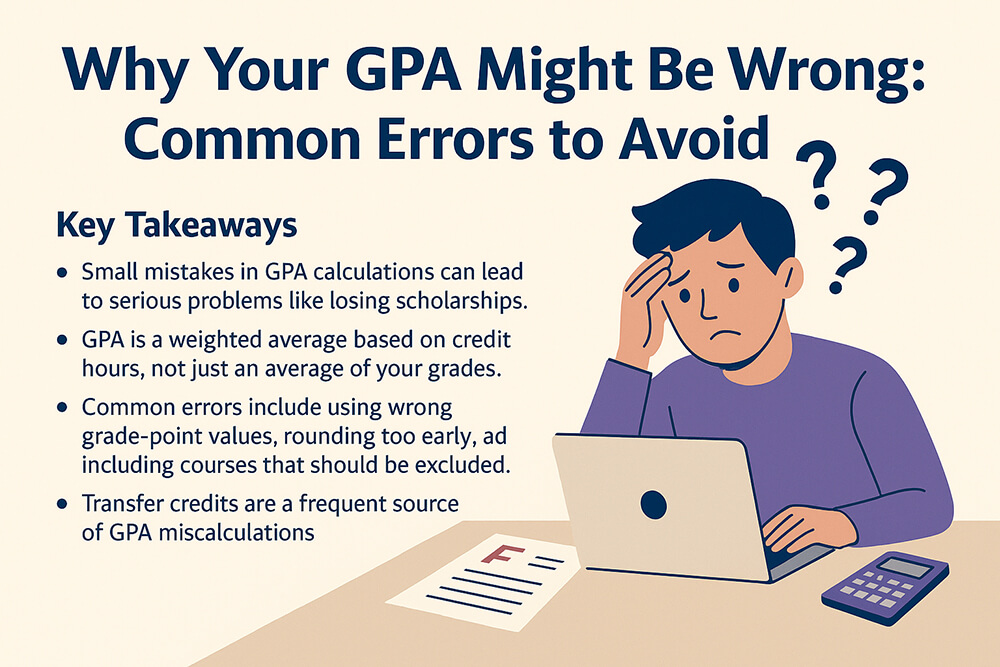
Small mistakes can move a GPA by a lot, especially near a 4.0. The most common schedule errors are simple:
- Wrong credits: using 1.0 for a class that is really 0.5 or 2.0
- Mixing scales: using plus/minus points with a straight-letter chart
- Averaging course GPAs instead of credits: a shortcut that breaks with uneven credits
- Rounding too early: rounding each class first, then averaging
- Counting excluded courses: adding pass/fail or non-credit courses that the school ignores
A good habit is to write a small table: course, grade, credits, points, and points×credits. Then sum the totals once.
If the transcript still disagrees, the issue is often a local policy or a different conversion chart. Use /blog/common-gpa-calculation-errors-to-avoid and /blog/why-gpa-does-not-match-transcript.
“What-if” planning: use schedule examples to raise GPA faster

Schedule examples help with a clear goal: move a GPA by changing the grades that carry the most weight. The fastest wins often come from:
- improving a lower grade in a high-credit class
- avoiding an F that drags both points and confidence
- protecting time so core classes stay strong
A simple “what-if” check works well: swap one B to an A in the same credit class and recompute. Then compare that to raising one elective from B to A. The bigger credit class usually moves the number more.
Term GPA changes can also stack into cumulative GPA changes. A strong semester can lift the whole average, but only if credits are counted correctly. Use /blog/semester-gpa-to-cumulative-gpa-guide and test plans with https://thegpacalculator.com/calculator/cumulative.
Frequently Asked Questions
What is the fastest way to calculate unweighted GPA from a schedule?
Convert grades to points, multiply by credits, add totals, then divide by total credits. The steps match /blog/gpa-formula-guide.
How many B’s can still be a 3.8+ unweighted GPA?
It depends on class count and credits. In six equal-credit classes, one B lands near 3.83.
Do colleges care if a school only reports unweighted GPA?
Colleges still see course rigor on the transcript. A strong context note helps. Compare with /blog/weighted-vs-unweighted-gpa.
Do electives usually count in unweighted GPA?
Many schools count them, but some exclude specific electives. Check /blog/what-counts-in-unweighted-gpa.
Can pass/fail hurt unweighted GPA?
A pass often adds credit with no points, but a fail can count as 0.0. Local rules vary.