
| Key takeaway | What it means for Conditional Admission GPA Policies |
|---|---|
| Conditional admission is real acceptance | You start classes right away, but you must hit set grades fast. |
| Most conditions target a 3.0+ term GPA | Many programs require 3.0 by the first term (or first two courses). |
| It is common in master’s and online programs | Nursing, education, counseling, and regional universities use it often. |
| Law and med school use different systems | Law uses probation after enrollment; med uses bridge programs. |
| The first semester is high-risk | One bad term can lead to dismissal, so the plan must be simple and safe. |
What conditional admission means in plain terms
Conditional admission means a school says “yes,” but adds rules. You enroll as a real student right away. You take classes like everyone else. The difference is you must meet a clear condition, usually by the end of your first semester.
Most programs set conditions like:
- Earn 3.0+ GPA in the first term
- Earn B or better in core courses
- Pass a set number of credits with solid grades
The goal is proof. The school wants to see you can handle the work now, not just on paper. Some programs use human review, so effort and communication can matter. Some programs enforce rules fast and strictly, so you must treat the first term like a test.

If you are unsure about your GPA math, start with how to calculate GPA.
Why schools offer conditional admission
Schools use conditional admission to balance access and standards. Many applicants have a low GPA for one clear reason: a bad first year, a family event, a major change, or poor study habits early on. Conditional admission gives a second chance without lowering the bar for graduation.
This approach also helps programs fill seats in fields with strong demand, like nursing and education. It can also help career changers who have good work history but uneven grades. Programs still protect outcomes, because students who miss the condition can be removed.
If GPA rules feel confusing across schools, that is normal. A 3.0 at one school can take different credit rules at another. A quick audit can prevent mistakes: transcript GPA audit guide.

Common GPA cutoffs and time limits you will see
Most Conditional Admission GPA Policies share a simple shape: low entry GPA, then a higher performance requirement. Many programs accept applicants around 2.5–3.0, then require 3.0 during the conditional period.
A typical pattern looks like this:
| Program type | Entry GPA range (common) | Condition (common) | Time limit |
|---|---|---|---|
| Master’s (regional) | 2.5–3.0 | 3.0 term/cumulative | 1 semester |
| Nursing master’s | 2.75–3.0 | 3.0 | 1 term or 1 year |
| Education programs | 2.75–3.0 | 3.0 | 1 semester |
| Psychology/counseling | 2.75–3.0 | 3.0 | first 2 courses |
| Online programs | 2.5–3.0 | 3.0 | varies |
If you need to forecast your first-term target, use semester GPA calculator.

Conditional admission vs academic probation: not the same thing
People mix these up. Conditional admission is an entry pathway. Academic probation is a warning system for students who are already enrolled and fall below standards.
Law schools usually do not admit students “conditionally” at the start. They admit students normally, then place them on probation if grades fall too low. This probation can trigger course limits, required programs, or dismissal if the GPA does not recover.
Some nursing and education programs also use probation during enrollment. That system is about staying in good standing after you start, not about getting your first offer.
If you want to compare how strict schools can be, it helps to know the bigger admissions picture: GPA requirements for college admissions.

Why med schools use bridge programs instead of conditional admission
Medical schools rarely admit students into an MD program with a “prove it later” condition. They usually use bridge or pathway programs instead. These are separate programs, often master’s programs, where you must earn a strong graduate GPA to earn better chances at an interview.
This system fits the high-stakes nature of medical licensing. It also gives schools more time to evaluate a student’s readiness. Bridge programs can be expensive and longer than conditional admission, but they offer a clearer way to rebuild a record.
If you want a strict GPA benchmark contrast, compare with medical school GPA averages AMCAS 2024–2025.

Where conditional admission shows up most often
Conditional admission is most common in programs that have strong job demand and broad applicant pools. You see it often in:
- Master’s programs at regional universities
- Nursing master’s programs
- Education and teacher certification programs
- Counseling and psychology programs
- Online graduate programs
- Part-time and evening programs
It shows up less often in top-tier PhD programs and in high-selectivity pipelines. If you are aiming at research degrees, the rules can look different. For example, many PhD tracks screen hard and then focus on research fit: PhD GPA requirements.
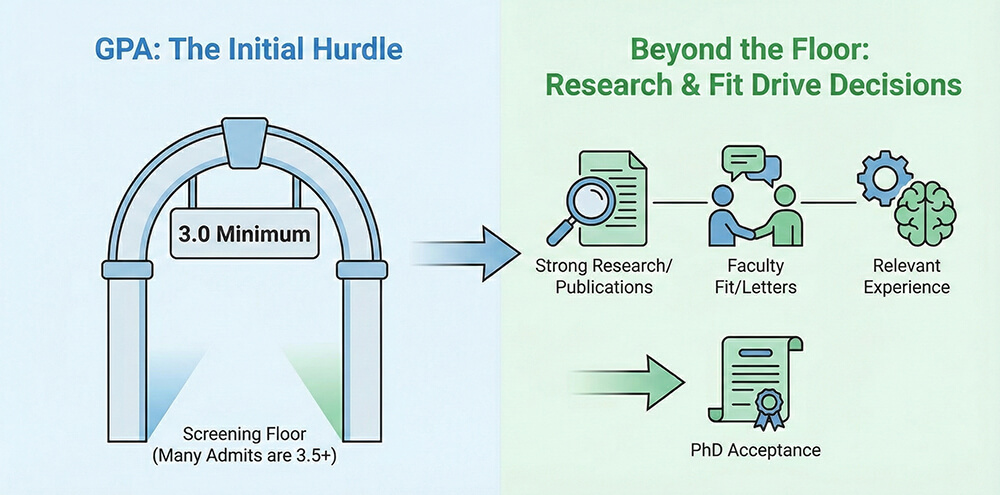
If you are aiming for applied STEM master’s programs, check MS engineering GPA requirements.
Who benefits most from conditional admission
Conditional admission works best for students who can perform right away. The first term is a short test window, so you need stable time, energy, and study structure.
It tends to fit students who have:
- A clear reason for low GPA (early-year slump, life event, major change)
- Strong recent grades or a strong “last 60 credits” trend
- Good work habits and strong schedule control
- Motivation backed by a realistic plan
It fits poorly when someone has no recent academic practice and no plan. A quick check can help you see where you stand: last 60 credits GPA calculator.

If your grades dipped due to poor systems, start with study tips for better grades.
How to plan the first semester so you do not lose the offer
Conditional admission gives you a fast start, but it gives you no space for a slow start. The first term should be simple and safe.
A strong plan often includes:
- Take fewer hard courses at once
- Avoid stacking math-heavy classes together
- Use office hours in week one, not week ten
- Build a weekly routine and protect study time
- Track grades every week so you do not guess
If you want a simple structure, use time management templates for GPA and study habit audit checklist.

If you want a week-by-week grade forecast, use mid-term grade projection slider.
How to use work experience as a GPA offset
Many conditional offers go to people with relevant work history. Work experience can show maturity, reliability, and skill. It can also give your statement more power because you can point to real work results.
A clean way to frame experience is:
- What you built or improved
- What tools you used
- What impact you had
- How it connects to the program
This matters in applied fields like engineering and business. If you are aiming at engineering programs, compare admissions flexibility with MS engineering GPA ranges.

If you want to show credit strength across programs, use credit hour weighting GPA guide.
What can go wrong: strict enforcement and no retake window
Some programs enforce conditional rules hard. Some do not allow course repeats during the conditional period. Some dismiss quickly if you miss the requirement, even by a small amount.
Common risk points:
- You assume you can “fix it later”
- You take too many classes at once
- You ignore the grading policy in the syllabus
- You do not ask for help early
- You miscalculate your target GPA
Avoid math mistakes with GPA formula guide and common GPA calculation errors to avoid.
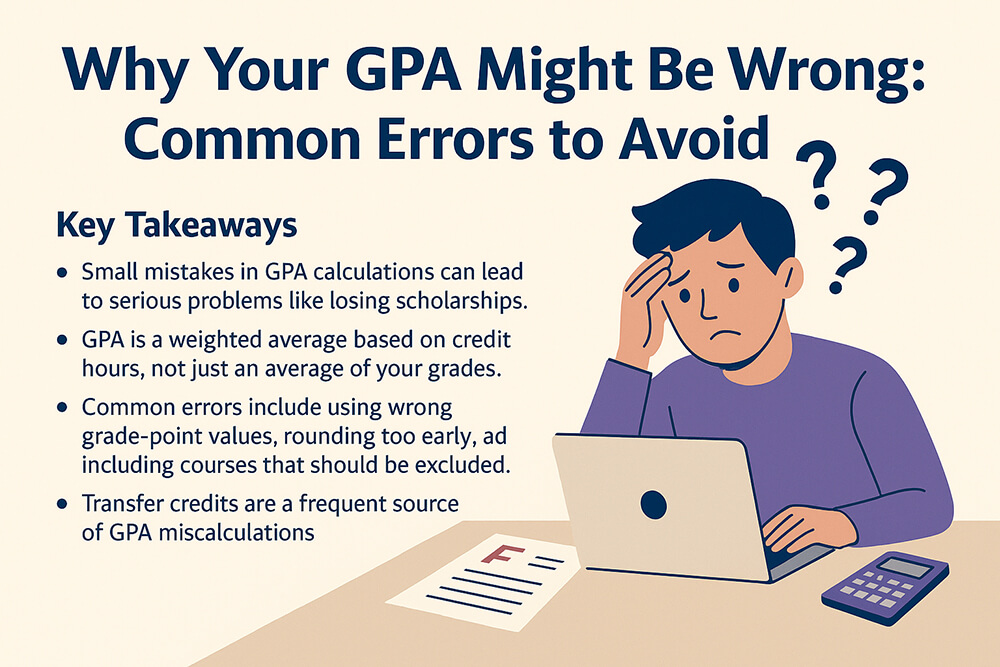
If your school uses letter-grade conversion rules, check letter to point GPA conversion guide.
Better alternatives when conditional admission feels too risky
Conditional admission is the fastest path, but it is not always the safest. If your GPA is very low, or you have been away from school for years, slower paths can work better.
Common alternatives:
- Master’s first: build a full year of strong grades and new letters
- Post-bacc classes: raise GPA and show strong recent performance
- Bridge/prerequisite plan: take targeted courses and rebuild confidence
- Work experience: build a stronger profile, then apply again
If you want a clear recovery playbook, use post-bacc GPA boost strategies.

If you are deciding whether to repeat courses, test the payoff with grade replacement ROI calculator.
International students: GPA conversion and policy differences
Conditional admission can be common for international students in some programs, but GPA conversion adds uncertainty. Different schools convert GPAs differently, so the same transcript can look stronger or weaker depending on the method.
If you apply as an international student, keep your conversion consistent and document your scale. Start with international GPA converter guide. If you use a national scale, use the matching guide like Nigeria 5-point to US 4.0 conversion or Ontario 12-point to 4.0 conversion guide.

If you are converting a percent scale, use percentage to 4.0 GPA conversion.
Frequently Asked Questions
What is conditional admission in graduate school? Conditional admission means you start classes right away, but you must meet a set GPA or grade rule in your first term. Many policies are summarized in conditional admission GPA policies.
Is conditional admission the same as probation? No. Conditional admission is an entry pathway. Probation happens after you enroll and your grades drop below standards.
What GPA do I need to keep conditional admission? Many programs require 3.0 by the end of the first semester or first two courses. Use semester GPA calculator to plan the target.
Can I get conditional admission with a 2.5 GPA? Some programs consider 2.5–2.9, especially online and regional master’s programs. The risk rises because the first term has no room for mistakes.
What if I have incomplete grades on my transcript? Incomplete grades can delay review and make your GPA look unclear. Plan fixes early with GPA planning for incomplete grades and incomplete grades scenario planner.
Do med schools offer conditional admission to MD programs? Most do not. They often use bridge or master’s pathway programs instead. Compare GPA expectations with medical school GPA averages AMCAS 2024–2025.
How can I avoid losing a conditional offer in my first semester? Keep the first term simple, track grades weekly, and get support early. A strong routine helps: time management templates for GPA and study habit audit checklist.
What is the best alternative if conditional admission feels too risky? A post-bacc or a master’s-first plan often gives more time to prove you can perform. Start with post-bacc GPA boost strategies and run the numbers on course repeats with grade replacement ROI calculator.