
| Key Takeaways | What to remember |
|---|---|
| Unweighted GPA stays on a 0.0–4.0 scale | Course level (Honors/AP/IB) does not add extra points. |
| Letter grades convert cleanly | A/A+ = 4.0, B = 3.0, C = 2.0, D = 1.0, F = 0.0 (plus/minus can shift by 0.3). |
| Percent-to-GPA conversion is school-specific | A 93% can mean A in one school and A- in another. |
| Credits matter | A 1-credit class should not weigh the same as a 4-credit class. |
| Some grades do not count | Pass/Fail, Incomplete, and some retakes often follow special rules. |
| Colleges often recalculate GPA | Report grades as shown on your transcript, not a self-made conversion. |
Unweighted GPA Calculator (4.0 Scale): what it does and who needs it

An Unweighted GPA Calculator (4.0 Scale) turns your course grades into one clear number from 0.0 to 4.0. It treats every class the same on the scale. An A in AP Calculus and an A in regular English both count as 4.0 in an unweighted system.
This matters if your school shows a weighted GPA above 4.0 and you want the unweighted view for a quick reality check. It also helps parents and students compare grades across semesters without guessing.
If you track grades across years, use a cumulative GPA calculator that can combine terms and credits in one place: cumulative GPA calculator. For a simple overview of tools and guides, start at The GPA Calculator home.
Standard unweighted GPA conversion chart (letter grade → 4.0 points)

Most unweighted systems follow a letter-to-point chart. Plus/minus rules vary, but this chart matches what many schools use.
| Letter grade | Percent range (common) | Unweighted points |
|---|---|---|
| A+/A | 93–100% | 4.0 |
| A- | 90–92% | 3.7 |
| B+ | 87–89% | 3.3 |
| B | 83–86% | 3.0 |
| B- | 80–82% | 2.7 |
| C+ | 77–79% | 2.3 |
| C | 73–76% | 2.0 |
| C- | 70–72% | 1.7 |
| D+ | 67–69% | 1.3 |
| D | 63–66% | 1.0 |
| D- | 60–62% | 0.7 |
| F | Below 60% | 0.0 |
If you want a deeper chart and edge cases, use the letter-to-point GPA conversion guide and compare it with your local rules in the high school grading scales chart.
Percentage-to-4.0 conversion: why one “easy formula” can mislead you

Many students try a quick method like percent ÷ 25. It feels simple, but it can be wrong. A 93.8% becomes 3.75 with that math. Another method turns 93.8% into an A and gives 4.0. Both results cannot match the same school scale.
A safer approach is: percent → letter grade → points. That keeps your work close to how transcripts and many schools report grades.
Still, even percent ranges vary by school. One school may set A- at 90–92. Another may set it at 91–93. Small shifts can move your GPA by 0.3 for a class.
If your grades start as percentages, use a tool that supports your school’s rules: percentage-to-4.0 GPA conversion and confirm ranges in the high school grading scales chart.
The unweighted GPA formula with credits (quality points done right)

Unweighted GPA is not “average your letters.” It is weighted by credits in many schools. The clean method uses quality points:
- Convert each course grade to GPA points (A = 4.0, B+ = 3.3, etc.)
- Multiply points by credit hours
- Add the results
- Divide by total credits
Example:
- AP Computer Science (4 credits): A = 4.0 × 4 = 16.0
- Spanish III (3 credits): B+ = 3.3 × 3 = 9.9
- History (4 credits): A- = 3.7 × 4 = 14.8 Total GPA = (16.0 + 9.9 + 14.8) ÷ 11 = 3.8
This is the same logic many calculators use under the hood. If your school uses different credit values per class, credits can change your result fast.
For clear definitions and examples, use quality points vs GPA explained and the credit hour weighting guide.
What counts in your unweighted GPA (and why students get this wrong)

Most schools include letter-graded courses taken during the official high school period they track. That often covers core classes and many electives, but your district can set limits.
Common items that usually count:
- Semester or trimester grades with A–F
- Most core subjects (English, math, science, social studies)
- Electives that give a letter grade
- Dual-enrollment or transfer work (the credit may count, but GPA handling can differ)
The best way to avoid guesswork is to match each class to your transcript and check how it reports credits and grade type. If your transcript lists a grade as P or CR, that often means it will not change GPA.
If you want a clean method to spot missing items, use a transcript GPA audit guide and compare subject rules with core vs elective GPA.
What does not count: pass/fail, incompletes, retakes, and pre-high-school credits

Some grades confuse students because they still “count” for credit, but they do not change GPA.
Common exclusions in many schools:
- Pass/Fail (P/F) or Credit/No Credit (CR/NCR) grades
- Incomplete (I) or In Progress (IP) grades until a final letter grade posts
- Some pre–9th grade courses (many districts exclude them from high school GPA)
- Retakes, where the school may replace, average, or keep both attempts
Retakes are the big one. A new grade can help a lot if your school replaces the old grade. It can help less if the school averages both tries.
If you want to model real outcomes, check how pass/fail grades impact your GPA, use the repeat course GPA recalculator, and plan around missing grades with GPA planning for incomplete grades.
Plus/minus grades and school grading scales: the small rules that move your GPA
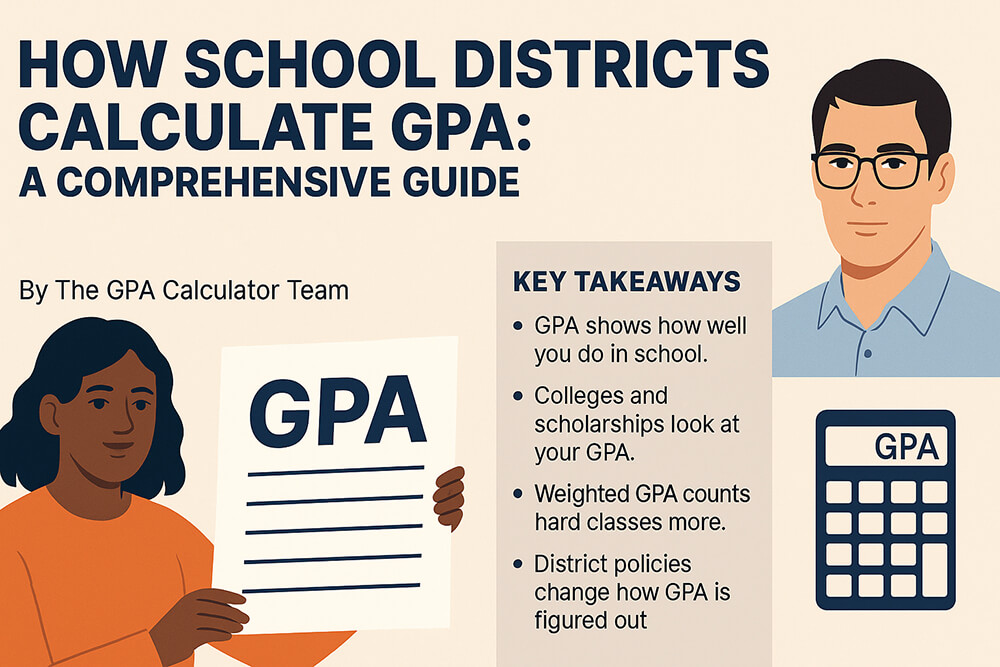
Plus/minus grading can change GPA in small steps:
- A- often equals 3.7
- B+ often equals 3.3
- B- often equals 2.7
But some schools do not use plus/minus at all. They may treat all A’s as 4.0 and all B’s as 3.0. Some schools also round percentage grades in ways that shift the final letter grade.
That is why two students with the same percent average can end up with different GPAs in different districts. It is also why a calculator should let you match your school’s policy instead of guessing.
If your GPA feels “off” by 0.1–0.3, plus/minus rules are a likely reason. Scale rules can also change by course type, term, or department.
For real policy examples, use how school districts calculate GPA and confirm your ranges in the high school grading scales chart.
Unweighted vs weighted GPA: same grades, different story

Unweighted GPA shows your raw grades on a fixed scale. Weighted GPA adds bonus points for advanced courses in many schools.
| Feature | Unweighted GPA | Weighted GPA |
|---|---|---|
| Scale | 0.0–4.0 | often 0.0–5.0+ |
| Honors/AP bonus | No | Yes |
| Max possible | 4.0 | can exceed 4.0 |
| What it signals | grade results | grade results + course rigor |
Two students can both have a 3.8 unweighted GPA. One may have a 4.4 weighted GPA because they took more AP classes. The other may have a 3.8 weighted GPA because they took mostly standard level classes.
Selective schools often look at both. Unweighted shows consistency. Weighted shows challenge level.
If you want a side-by-side check, use the weighted vs unweighted GPA guide and compare numbers in the weighted vs unweighted GPA calculator.
Why colleges recalculate GPA (and why your number may not match theirs)

Many colleges do not use your transcript GPA as-is. They often recalculate to compare students across schools with different rules. A college may:
- focus on core academic classes
- ignore some electives
- treat honors/AP credit in its own way
- use a fixed letter-to-point system
Some systems also limit which years count for a special GPA method. Others look at rigor as context instead of adding points in a strict way.
This can feel unfair, but it helps admissions teams compare files with one yardstick. It also explains why a student’s GPA can look different across websites, school reports, and college portals.
A smart rule: report grades in the format your school uses, then let colleges do their own math. If you want to know why your number shifts, read why GPA does not match transcript and compare standards in GPA requirements for college admissions.
Common unweighted GPA mistakes: quick fixes that prevent bad math
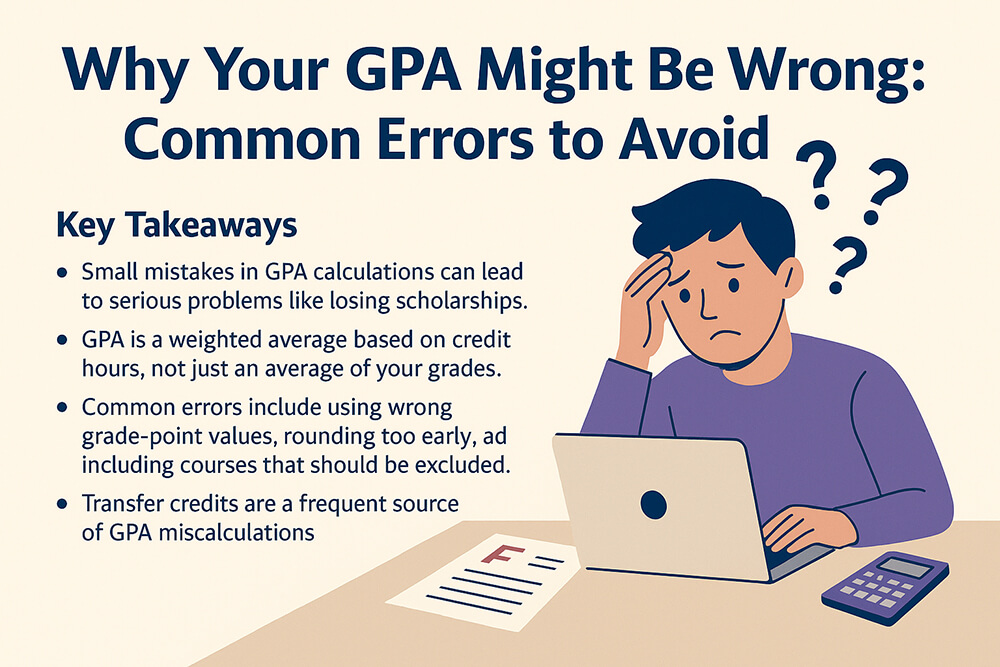
Small mistakes can move GPA more than you expect. These are the most common:
- Using percent ÷ 25 and calling it “official”
- Ignoring credits and averaging classes the same
- Mixing weighted and unweighted points
- Rounding too early (round only at the end)
- Counting pass/fail classes as A’s
A fast fix is to keep one clean pipeline: letter grade → points → credits → final average. If you start with percentages, convert to letters using your school’s scale first.
If you see a GPA that feels too high or too low, check two things right away: (1) credit hours, (2) plus/minus rules. Those cause the biggest “mystery gaps.”
For a clean walkthrough, use common GPA calculation errors to avoid, learn the math in the GPA formula guide, and verify steps in how to calculate GPA.
“What-if” planning: figure out the grades you need for a target unweighted GPA

Students often want answers like: “What grades do I need next term to hit a 3.5?” You can solve that with the same quality-points math.
Start with:
- your current total quality points
- your current total credits
- your planned credits next term
Then test grade combos for next term and see the new average. This helps you set goals that match reality. It also helps you choose where effort pays most. A high-credit class can move GPA more than a low-credit class.
If you want to plan mid-term changes, use tools that let you slide future grades and see the result. That makes the goal feel concrete, not scary.
For planning help, try the mid-term grade projection slider, set targets with the GPA goal setting worksheet guide, and build habits with the raise my GPA action plan.
Track unweighted GPA across semesters, transfers, and dual enrollment

Unweighted GPA gets messy when you combine multiple terms, new schools, and mixed credit types. A clean tracker should let you enter each term and keep credits attached to each class.
If you transferred schools, your transcript may list transfer credits without a GPA impact, or it may import both credit and grade. Dual-enrollment can also follow a different rule than regular high school classes. That is why “one number” can hide different policies.
A good habit is to store each term as a separate block, then let the calculator build the cumulative total. That makes it easy to spot where your GPA changed and why.
To track everything in one place, use the cumulative GPA calculator, handle term-by-term entry with the semester GPA calculator, and reconcile outside credits with the transfer credits GPA integrator.
Frequently Asked Questions
How do I convert percentage grades to an unweighted 4.0 GPA?
Use your school’s percent-to-letter ranges, then convert the letter to points. Avoid percent ÷ 25 if your school uses plus/minus or custom cutoffs. Use the percentage-to-4.0 GPA conversion to match common ranges.
Can an unweighted GPA go above 4.0?
No. Unweighted GPA caps at 4.0 because it does not add honors/AP bonus points. If your GPA shows 4.2, that is a weighted number. Compare both in the weighted vs unweighted GPA guide.
Does an A+ count as 4.3 on the unweighted scale?
Most schools still count A+ as 4.0 in an unweighted system. Some schools treat A+ the same as A, and some do not even show A+. Check your policy in how school districts calculate GPA.
Do pass/fail classes change my unweighted GPA?
Usually no. Pass/Fail often gives credit without changing GPA. Confirm your rule in how pass/fail grades impact your GPA.
How do retakes affect my unweighted GPA?
Schools may replace the old grade, average both tries, or count both. Your outcome depends on that rule, not on one universal formula. Test scenarios with the repeat course GPA recalculator.
Should I report weighted or unweighted GPA on college applications?
Report what your school reports, and follow the application’s prompt. Many schools review both, and many colleges recalculate anyway. If you feel stuck, use should you report weighted or unweighted GPA.
Why does my GPA not match what a college says it uses?
Colleges often recalculate to compare students across different schools and grading rules. That can change which courses count and how points are assigned. See the common reasons in why GPA does not match transcript.
How do I handle different credit hours in GPA math?
Multiply each course’s GPA points by its credits, then divide total quality points by total credits. This keeps your result fair when class credits vary. Use the credit hour weighting guide for examples.
What is the easiest way to track GPA across multiple semesters?
Store grades by term and let a cumulative tool combine them. This makes it easy to spot the term that changed your GPA most. Use the cumulative GPA calculator and the semester GPA calculator for clean tracking.