
| Key Takeaways | What it means for your GPA |
|---|---|
| Convert semester GPA to cumulative GPA using quality points, not simple averages. | Cumulative GPA = total quality points ÷ total credits. |
| Credits are the “weights.” | A 16-credit semester matters more than an 8-credit semester. |
| Averaging semester GPAs is usually wrong. | It can miss by 0.05–0.25+ when credits are uneven. |
| Your district rules can change the result. | Plus/minus, weighting, retakes, and what counts vary by school. |
| Use a calculator that shows the math. | Transparency helps you catch transcript mismatches early. |
Semester GPA vs cumulative GPA: what each number really means
A semester GPA is one term only. It uses the grades from that term and turns them into one number. A cumulative GPA is the total story from 9th grade to now. It blends every term and every class together.
Colleges and scholarships usually care more about cumulative GPA because it shows consistency. One great semester helps, but it does not erase earlier grades. The key point is simple: cumulative GPA is not a “semester average.” It is a credit-weighted average of all classes.

If you want a fast check for your school setup, use a high school GPA calculator that matches your grading scale and course levels. You can start with the High School GPA Calculator and compare it to your transcript. Helpful tools: cumulative GPA calculator, high school GPA calculator
The core formula for converting semester GPA to cumulative GPA
The correct method uses quality points. This is the number your transcript math runs on.
Cumulative GPA = Total Quality Points ÷ Total Credits Quality Points = Grade Points × Credits
So an A (4.0) in a 3-credit class gives 12.0 quality points. Do that for every class, add them up, and divide by total credits. This is why two semesters with the same GPA can affect you differently. If one semester has more credits, it adds more quality points.

If your school gives you a “semester GPA” but you do not know your course credits, ask your counselor for a credit list. Without credits, you can’t weight semesters correctly. Read deeper: quality points vs GPA explained, GPA formula guide
A quick shortcut: using semester GPA × semester credits
You can convert semester GPAs into a cumulative GPA only if you also know each semester’s total credits.
Cumulative GPA = (Σ (Semester GPA × Semester Credits)) ÷ (Σ Semester Credits)
This shortcut works because a semester GPA already “bundles” that term’s classes. Multiplying by semester credits rebuilds the quality points total. Then dividing by total credits gives the same result as the full course-by-course method.
Still, this shortcut breaks if your school reports final year grades instead of separate semester grades for each course. Some transcripts show a final grade that already blends both terms. If you count both semester grades and the final grade, you double count.

If your transcript confuses you, audit your data before you trust the number. Related: credit hour weighting GPA guide, why GPA does not match transcript
Worked example: four semesters converted into one cumulative GPA
Here is a clean way to think about the math: each semester adds quality points and credits.
If your four semesters have different totals (like 14, 12, 11, 13 credits), you must weight them. Add up all quality points across all semesters, then add up all credits, then divide.
A common surprise: the final cumulative GPA may look close to the average of the semester GPAs, but that can be luck. When semester credit loads are similar, averaging “looks right.” When credit loads change, averaging fails.
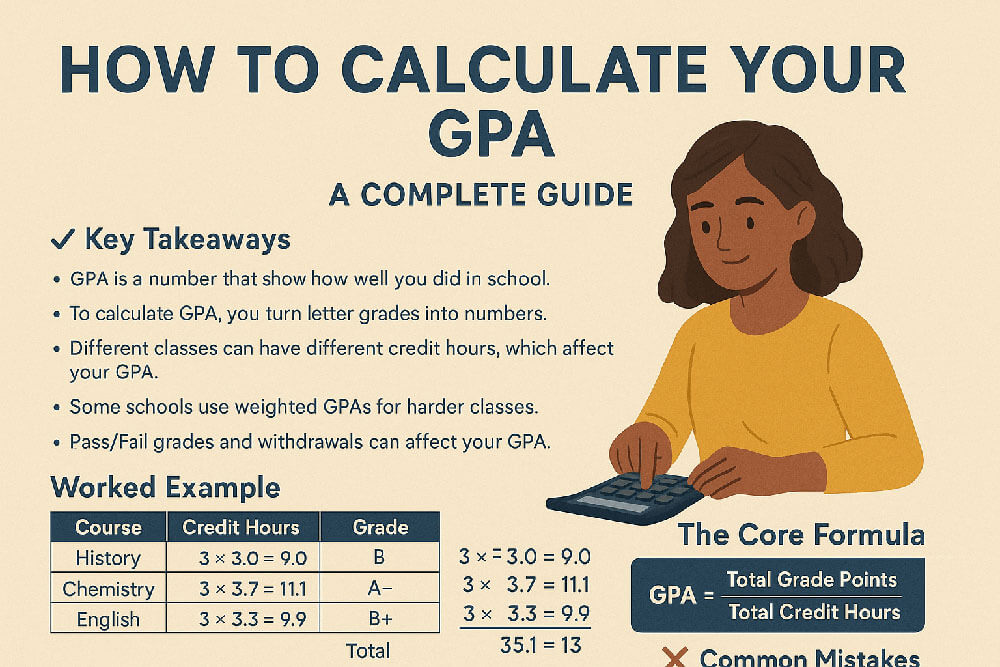
To avoid mistakes, write a small table: Semester, GPA, Credits, GPA×Credits. Then sum the last two columns. More help: how to calculate GPA, how to calculate high school GPA
Why averaging semester GPAs is the #1 mistake
Many students do this: (3.8 + 3.5) ÷ 2 = 3.65
That only works when both semesters have the same credits. If one term has more classes (or more lab credits), it should count more. A direct average treats each semester like a 50/50 split, even when the credits are 16 and 8.
That can create a “fake” GPA that is higher or lower than your true cumulative GPA. Even a 0.10 change can matter for class rank, honors, and scholarship cutoffs.
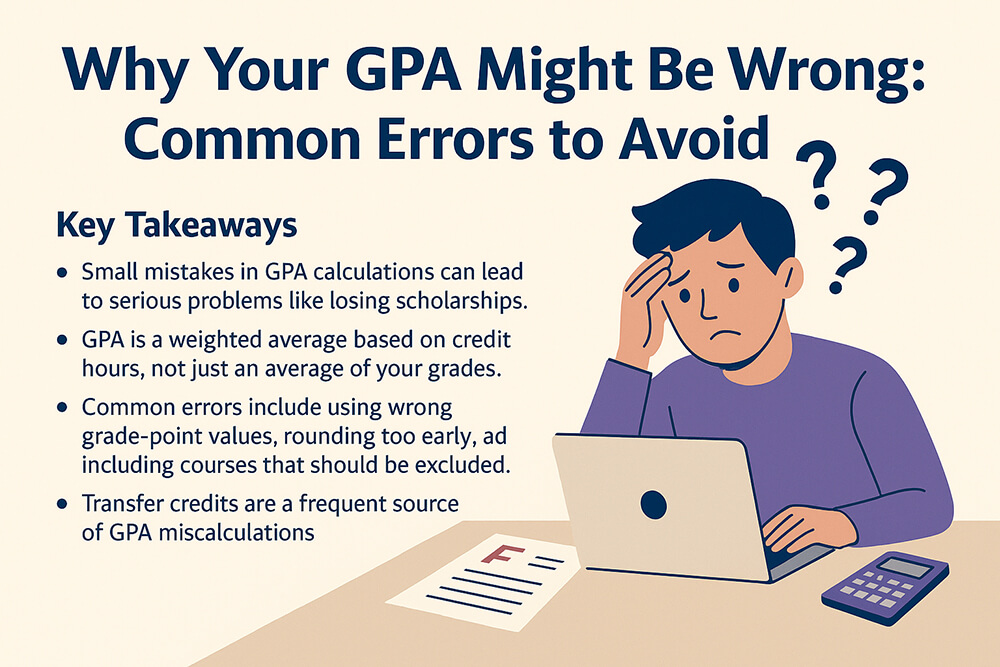
If your number feels off, check the credits first. Then check if your school uses plus/minus or not. Related: common GPA calculation errors to avoid, GPA formula guide
Credit hours control the “weight” of each semester
Think of credits like votes. More credits = more votes in your cumulative GPA.
Example:
- Semester A: 3.9 GPA, 18 credits
- Semester B: 3.2 GPA, 6 credits
Averaging says (3.9 + 3.2) ÷ 2 = 3.55. Weighted math says (3.9×18 + 3.2×6) ÷ 24 = 3.775.
That is a big difference. It happens because the strong semester has three times the credits, so it should count three times as much.

If you want your calculator to match your transcript, always enter credits and course level when your school uses it. Read more: credits and course level input guide, credit hour weighting GPA guide
Weighted vs unweighted cumulative GPA: don’t mix them
Most schools can show two GPAs:
- Unweighted cumulative GPA (often 0.0–4.0)
- Weighted cumulative GPA (can go above 4.0)
Unweighted treats an A in PE and an A in AP Calculus the same on the GPA scale. Weighted adds bonus points for Honors/AP/IB/Dual Enrollment. The hard rule: never combine weighted and unweighted numbers in one calculation.
If you want a clean college comparison, stick with unweighted unless a form asks for weighted. If you report weighted, label it clearly.

If your school has both, calculate both and keep them separate in your notes. Related: weighted vs unweighted GPA guide, should you report weighted or unweighted GPA
Plus/minus grading can change your cumulative GPA
Some districts use plus/minus (A-, B+, B-). Others do not. That one policy can move your GPA without you changing a single grade.
Example scales:
- With plus/minus: A- = 3.7, B+ = 3.3
- Without plus/minus: A- = 4.0, B+ = 3.0
If your friend in another district gets the same letter grades, your GPAs may still differ. When you convert semester GPA to cumulative GPA, you must use the same scale your school uses for the transcript.

If your school ignores plus/minus, do not “upgrade” a B+ to 3.3 in your own math. Match the policy. Related: letter to point GPA conversion guide, unweighted GPA plus/minus calculator
Pass/fail, incompletes, and midterm grades: what counts and what doesn’t
Not every mark affects GPA the same way.
Pass/fail often gives credit without GPA points. That means it can change credits earned, but not quality points. Your cumulative GPA can stay the same while your total credits rise. Incompletes can also sit on your record as a placeholder until you finish work. Some schools treat an incomplete as “no GPA yet,” while others use a temporary grade.
Midterm grades usually do not count in cumulative GPA unless your school posts them as final marks.

If you are planning your next term, run scenarios with and without the incomplete resolved. Related: how pass/fail grades impact your GPA, GPA planning for incomplete grades
Retaken courses: replacement vs averaging policies
Retakes can change your cumulative GPA a lot, but only if you know your school rule.
Common policies:
- Replacement: the new grade replaces the old one in GPA math.
- Averaging: the old and new grades both count (or get averaged).
Replacement helps you recover faster. Averaging still helps, but less. This is why two students can retake the same class, earn the same new grade, and end with different cumulative GPAs.
Also watch for credit rules. Some schools give credit only once, even if they show both attempts on the transcript.

Before you retake a class, check the handbook or ask counseling staff which policy your district uses. Related: repeat course GPA recalculator, how school districts calculate GPA
When your calculator and transcript don’t match
A mismatch usually comes from one of these issues:
- Wrong grading scale (plus/minus vs no plus/minus)
- Mixed weighted and unweighted data
- Wrong credits (semester vs year-long credits)
- Final grade counted twice (semester grades + final)
- Missing classes (electives, PE, or middle school credit rules)
A good fix is a transcript audit. List every course, the credits, the final grade used for GPA, and the course level. Then rebuild quality points and compare the final number.

This sounds slow, but it is the fastest way to catch a hidden policy issue before applications go out. Related: transcript GPA audit guide, why GPA does not match transcript
How to plan your next semester to raise cumulative GPA
Cumulative GPA changes based on two levers:
- Your next semester GPA
- How many credits that semester adds
A strong semester with more credits moves the needle more. A strong semester with fewer credits still helps, but slower. This is also why early semesters matter. When you have fewer total credits, each class is a bigger share of your cumulative.
A simple planning method:
- Calculate your current total quality points (current GPA × total credits).
- Add a target semester: (target GPA × next semester credits).
- Divide by new total credits.

If you feel stuck, choose one class to improve first and track the grade change weekly. Related: raise my GPA action plan, GPA goal setting worksheet guide
Use tools that match high school transcripts, not college-only calculators
Many “GPA calculators” online are built for college terms and do not match high school systems. High schools can use:
- Year-long courses split into semester grades
- Weighted course levels (Honors/AP/IB)
- District-specific credit values
- Different rounding rules (two decimals vs three)
Pick a tool that lets you enter credits, course level, and grading scale, then shows the math. That makes it easy to prove where the number came from.

Start with a cumulative tool for the big picture, then use a semester tool for “next term” planning. Try these: cumulative GPA calculator, semester GPA calculator
Frequently Asked Questions
How do I convert semester GPA to cumulative GPA fast?
Multiply each semester GPA by that semester’s credits, add those results, then divide by total credits. This matches the quality points method when your semester GPAs are based on the same scale and credit system. Tool: cumulative GPA calculator
Why is averaging semester GPAs wrong?
Averaging gives every semester the same weight. Real cumulative GPA weights by credits, so a 16-credit semester counts more than an 8-credit semester. Reference: credit hour weighting GPA guide
Can I convert using only semester GPAs with no credits?
Not reliably. Credits are the weights. Without them, you cannot tell how much each semester should count. Ask your counselor for the credit totals, or use course-by-course input. Help: credits and course level input guide
Should I report weighted or unweighted cumulative GPA?
If a form does not specify, report unweighted and label it clearly (example: “3.47/4.0 unweighted”). If a school asks for weighted, report weighted and label it. Guide: should you report weighted or unweighted GPA
Do plus/minus grades (A-, B+) affect cumulative GPA?
Yes, if your district uses them in GPA math. If your district ignores plus/minus, an A- may still count as 4.0. Match your transcript policy. Guide: letter to point GPA conversion guide
Do pass/fail classes change cumulative GPA?
Often they add credits but do not add GPA points. That means your cumulative GPA may not move, even though you earned credit. Policies vary by school. Guide: how pass/fail grades impact your GPA
What happens to my GPA if I retake a class?
It depends on your school’s retake rule. Replacement can remove the old grade from GPA math. Averaging keeps both attempts in some form. Tool: repeat course GPA recalculator
My calculator number does not match my transcript. What should I check first?
Check grading scale (plus/minus), weighted vs unweighted, credit values, and whether you accidentally counted final grades twice. A transcript audit usually finds the issue. Guide: transcript GPA audit guide