| Key Takeaway | What it means for Finals Weighting and Semester GPA |
|---|---|
| Finals weight is a percent | A “20% final” means 80% is already set before the exam. |
| The final cannot “erase” the semester | It can only move your grade by its weight (10%, 20%, 40%, etc.). |
| One formula runs the whole story | Final Grade = Current Grade × (1 − Weight) + Final Exam × Weight |
| You can solve for the score you need | If the result is over 100%, the target grade is not possible without extra credit. |
| High weight can help recovery | A heavier final can give a struggling student a real path to lift the course grade. |
| Small drops can matter for GPA | A tiny percent change can flip A to A− or B+ to B, which changes GPA points. |
Finals weight is not “final exam score”
Finals weight is the share of your semester grade that comes from the final exam. It is not a measure of how hard the class feels. It is just math. If the final is worth 20%, then 80% of your grade comes from everything you already did. That 80% might include homework, quizzes, projects, labs, and unit tests.
Many students think the final “becomes the grade.” That is only true in exam-dominant courses. In most high school classes, the final weight sits near 10–20%. That means a bad final hurts, but it does not set your grade to the final exam score.
If you want to see how a course grade turns into GPA points, use a high school GPA calculator and cross-check the math with a clear GPA formula guide.
The one formula that controls your semester grade
Finals weighting uses one simple formula:
Semester Grade = (Current Grade × (1 − Finals Weight)) + (Final Exam Score × Finals Weight)
Write the weight as a decimal. So 10% becomes 0.10. A 40% final becomes 0.40.
This formula matters because it tells you the maximum damage or boost your final can create. If your current grade is 85% and the final is 10%, then even a perfect 100% can only lift the course grade by 1.5 points (because 85% already carries most of the weight). The reverse is also true. A weak final cannot destroy months of strong work if the weight is low.
If your numbers keep looking “off,” check common input issues like category weights and rounding in common GPA calculation errors to avoid, and verify your base grade using a semester GPA calculator.

Common finals weights and what they really change
Schools use many grading policies, but finals weight usually falls into a few bands. Lower weights reduce the final’s power. Higher weights make the final feel like a big swing.
- 5–10% (low weight): The semester work dominates. The final rarely changes a letter grade unless you sit near a cutoff.
- 10–20% (standard): The final can move the grade a few points. Letter-grade drops happen most often near boundaries.
- 20–30% (high): The final becomes a major event. A strong final can rescue a shaky semester.
- 30–50% (exam-heavy): The final can decide the course grade. One bad day can hit hard.
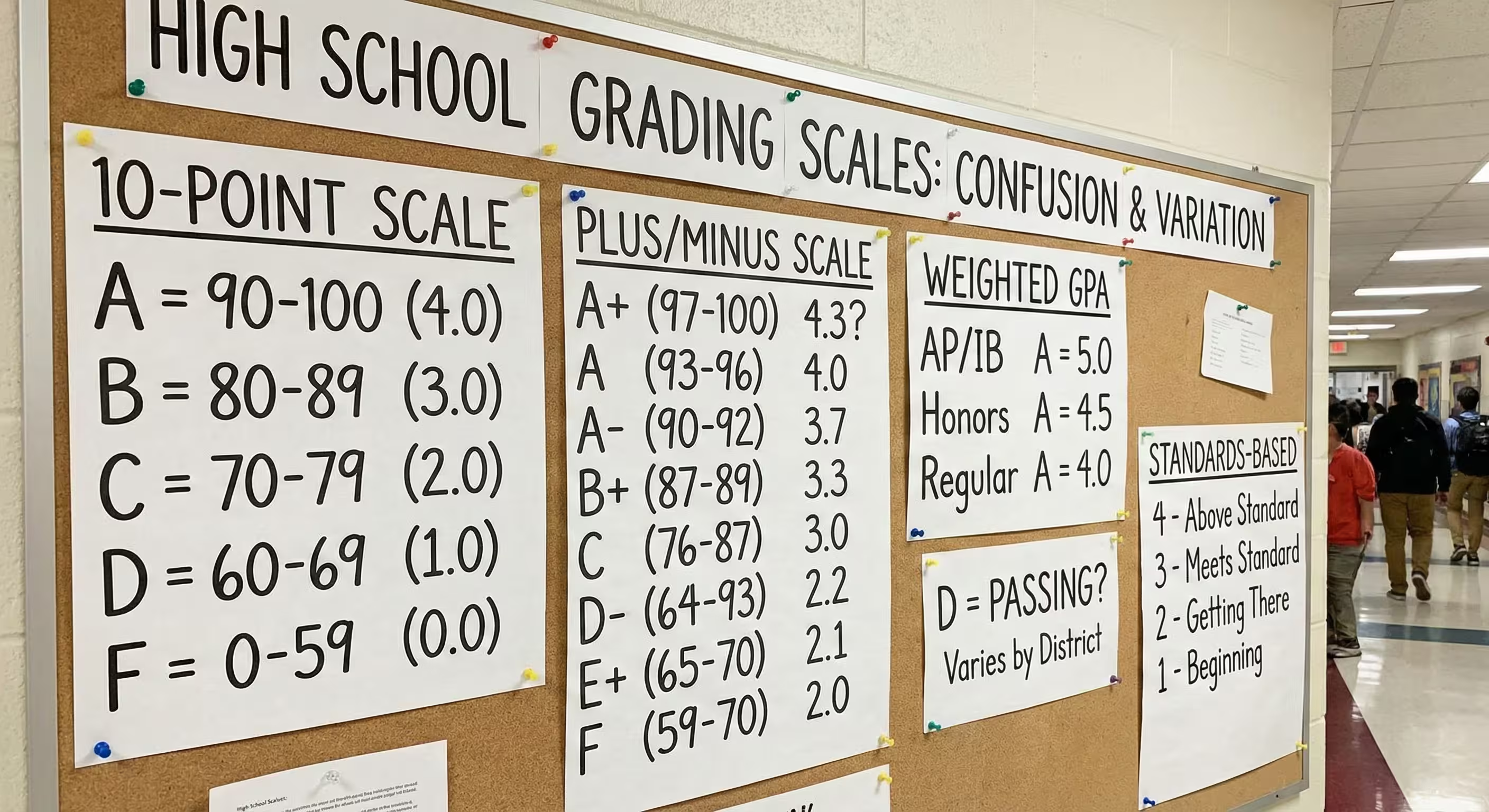
If you are not sure what your school uses, look at your course syllabus or ask your teacher. Also learn how your district turns percent grades into GPA points with a letter to point GPA conversion guide.

A worked example you can copy in 30 seconds
Use a real example to see the size of the change. Say your current grade is 85% and you score 78% on the final.
- 10% final: 85×0.90 + 78×0.10 = 76.5 + 7.8 = 84.3%
- 20% final: 85×0.80 + 78×0.20 = 68 + 15.6 = 83.6%
- 40% final: 85×0.60 + 78×0.40 = 51 + 31.2 = 82.2%
Same final score. Different outcome. The weight is the reason.
If you want to test “what if I get an 80, 85, 90, 95” fast, plug the numbers into your course plan, then check the GPA effect with the college GPA calculator or the cumulative GPA calculator if you track long-term goals.

Where to find your school’s finals policy
Finals weighting is not the same everywhere. Two schools in the same city can use different rules. Even inside one school, two teachers can weight tests in different ways.
Start here:
- Course syllabus (often lists category weights and final exam weight)
- Student handbook (district grading policy)
- Grade portal notes (some show “semester exam” as a category)
- Ask the teacher if the policy looks unclear
Also check whether finals sit inside a broader “tests” bucket. In test-heavy models, finals are not a separate line. They are part of the test category.
To understand how local rules shape GPA across classes, see how school districts calculate GPA and compare course types with weighted vs unweighted GPA explained.

Calculate the exact score you need on your final
This is the most useful move in finals week. Solve for the final exam score you need:
Final Needed = (Target Grade − (Current Grade × (1 − Weight))) ÷ Weight
Example:
- Current grade: 75%
- Target grade: 80%
- Final weight: 20% (0.20)
Final Needed = (80 − (75×0.80)) ÷ 0.20 = (80 − 60) ÷ 0.20 = 20 ÷ 0.20 = 100%
That is possible, but it is hard. A smarter plan is to aim for a high but realistic score and see where you land. If you want a clean way to track targets across classes, pair your course math with a midterm GPA estimate calculator guide and a how to calculate GPA refresher.

What it means when the number is over 100%
Sometimes the math tells you something you do not want to hear. If your “final needed” is 114%, your target grade is not possible without extra credit or a curve that pushes scores over 100.
This is still helpful. It saves you from chasing the wrong goal. It also helps you pick the best next target. Instead of “I need an A,” you can ask, “What is the highest grade that is still reachable?”
Do this:
- Lower the target grade by 1 point and recalc.
- Keep going until the final needed drops under 100.
- Pick a target that fits your time and stress level.
If your school uses plus/minus, small shifts matter. A grade can flip from A to A− from a tiny change. Use unweighted GPA plus minus calculator and check scale rules in types of GPA scales.

How grading structures change finals impact
Finals weight is only one part. The full grading structure can change how fast a grade moves.
Common models include:
- Four quarters + final: each quarter often counts the same, and the final can equal a whole quarter.
- Semester average + final: two half-year blocks carry most weight, with the final as a large add-on.
- Two-quarter reset system: grades reset each semester, so the final hits only that term.
- Test-heavy bucket: finals live inside the “tests” category, not as a separate line.
You should match your math to your real structure. If you mix models, you get wrong answers fast. A simple fix is to calculate the course grade first, then calculate GPA from the course grades. Use how to calculate high school GPA and confirm your timeline with semester vs quarter vs trimester GPA.
Recovery potential: why higher weight can help you
It sounds backward, but high finals weight can help a student who is behind.
If your final is only 10%, then 90% of your grade is already locked. A student sitting at 75% cannot jump to an 85% with a 10% final. The math makes it impossible.
If the final is 40%, the story changes. A strong final can lift a low current grade by a lot. Example:
- Current grade: 75%
- Final weight: 40%
- Final score: 100%
Final grade = 75×0.60 + 100×0.40 = 45 + 40 = 85%
So “high-stakes” cuts both ways. It can punish one bad day. It can also open a real comeback path.
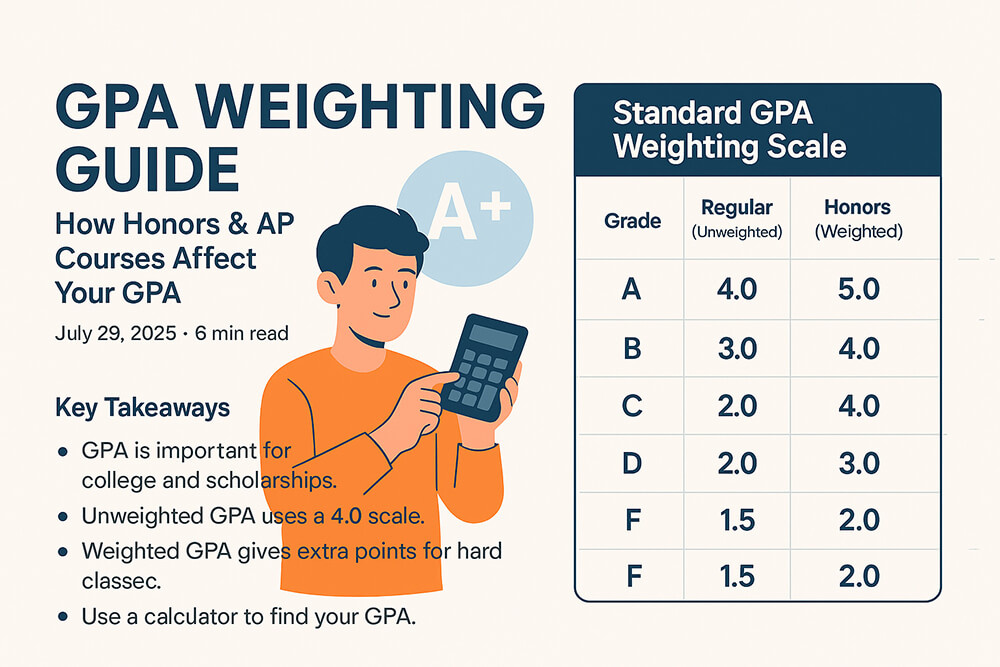
To see how course rigor and weighting interact, read GPA weighting guide for honors and AP and compare outcomes in a weighted vs unweighted GPA guide.
Semester GPA vs cumulative GPA: what colleges actually see
Finals change your semester course grades. Those course grades turn into a semester GPA. Then every semester GPA feeds your cumulative GPA.
So the final exam does not “directly” change cumulative GPA. It changes the course grade that goes on the transcript. That is what counts.
A small drop can matter a lot in competitive paths. A shift from A to A− can change GPA points. For high-stakes programs, even small GPA moves can affect admissions ranges.
If you want to track long-term impact, use the cumulative GPA calculator and learn what schools look for in GPA requirements for college admissions. If you aim at professional programs, compare benchmarks in GPA benchmarks for professional programs.

A study plan that matches your required score
Your required score should shape how you study. It should also shape how you manage time and stress.
Use three bands:
- Required 70–85: Focus on broad review. Cover every unit once. Do practice problems daily.
- Required 86–95: Cut low-value work. Spend more time on weak units and test-style questions.
- Required 96–100: Go laser-focused. Master the highest-frequency topics. Drill errors until they stop.
Keep the plan short and clear:
- Make a one-page topic list.
- Do timed practice.
- Fix mistakes the same day.
If you need practical routines, use study tips for better grades and a simple planner from time management templates GPA. If stress is high, a good plan helps because the numbers stop feeling mysterious.

Build a “what-if” view for every class
The best finals tool does more than one calculation. It should show you choices.
A strong finals view includes:
- Your current weighted grade
- The exact final score needed for a target
- A simple label like Realistic / Hard / Not possible
- A what-if table: “If I score 80 / 85 / 90 / 95 / 100”
- The GPA effect across the term
You can do this with two steps:
- Calculate the course grade with your class weights.
- Convert course grades into GPA points.
For step two, start with the high school GPA calculator. For long-term planning, pair it with the cumulative calculator. If your GPA does not match the transcript, use why GPA does not match transcript to find the gap.

Finals myths that cause panic
A few myths create extra stress in finals week. The fix is simple math and clean inputs.
Myth: “My final grade will be my final exam score.” Truth: Your grade is a weighted blend. A low final does not set your grade to that number unless the weight is huge.
Myth: “A high final weight means I am doomed.” Truth: High weight can also create recovery power if your current grade is low.
Myth: “Colleges only care about the final letter.” Truth: The final letter is what counts, but patterns matter too. A sharp drop can raise questions. Strong rebound grades help.
Use weighted GPA myths debunked for common confusion and check scale choices with 4.0 vs 5.0 vs 6.0 GPA scales. If you use pass/fail in any class, learn the rules in how pass fail grades impact your GPA.

Frequently Asked Questions
1) What does “final is 20%” mean in plain words?
It means 80% of your grade is already decided before you take the final. The last 20% comes from the final exam score. If you want to compute it fast, start with the semester GPA calculator and confirm the math in the GPA formula guide.

2) Can a final exam drop me a whole letter grade?
Yes. It happens most when you sit near a cutoff and the weight is 15–30% or higher. A small percent shift can flip A to A− or B+ to B. Use letter to point GPA conversion guide to see the GPA point change, and check your school scale in high school grading scales chart.
3) Why does my GPA not match my transcript?
Schools can recalculate GPA with special rules. They may treat honors/AP differently, ignore some grades, or round in ways you did not expect. Start with why GPA does not match transcript and confirm weighting rules in GPA weighting guide honors AP.

4) What if my required final score is over 100%?
Then the target grade is not possible without extra credit, a curve, or a policy change. Lower the target grade and recalc until the needed score drops under 100. For plus/minus cutoffs, use unweighted GPA plus minus calculator and check your grade-to-GPA mapping with GPA conversion charts tools.
5) Do finals affect cumulative GPA directly?
Finals affect your course grade for the term. That course grade feeds your semester GPA, and every semester GPA feeds your cumulative GPA. Track long-term impact with the cumulative GPA calculator and learn the big picture in how to calculate GPA.
6) What is the fastest way to plan finals for multiple classes?
Do the same three inputs for each class: current grade, finals weight, target grade. Then build a what-if table (80/85/90/95/100). If time is tight, fix the classes where the final has the biggest weight first. Use the high school GPA calculator for the full set, and add habits from study tips for better grades.

7) Does weighted vs unweighted GPA change finals math?
Finals math stays the same for the course percent grade. Weighted vs unweighted changes how that percent becomes GPA points. Honors/AP classes may add weight after the percent grade is set. Compare rules in weighted vs unweighted GPA explained and confirm reporting choices in should you report weighted or unweighted GPA.